


Solar-Powered Lithium Extraction From Seawater Works Without Membranes - But Can It Scale?
Published: 2026-11-24 13:10:28
Updated: 2026-11-24 05:11:27
See how sunlight extracts lithium from seawater in the lab and what a UK desalination pilot would need to measure before the process can scale.
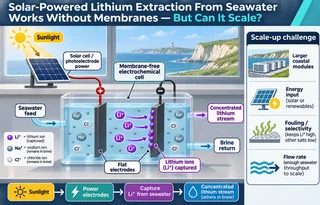
Can solar-powered lithium extraction from seawater scale?
Solar-powered lithium extraction from seawater works without an ion-selective membrane in the laboratory. Commercial scale remains unproven. At a representative seawater concentration, about 5.9 million litres contain one kilogram of lithium. A plant would need more water if it recovered only a fraction of that lithium. Whether the process can scale depends on how much water the plant can handle, how long the electrodes last, how daylight varies through the year and how much lithium ends up in a product that meets a buyer’s specification. Nature Water study · Seawater concentration benchmark
An existing desalination plant offers a practical setting for a pilot because it already handles a concentrated saline stream. The first step is to sample that stream and measure its lithium concentration and flow while the plant is running. Salinity measures total dissolved salts and gives little indication of how much lithium is available.
How sunlight drives lithium capture without a membrane
Light striking a titanium dioxide electrode generates a voltage. This brings the connected capture electrode, made from modified iron phosphate, into a voltage range where lithium ions can enter its solid structure. Competing ions such as sodium mostly stay in the water. The capture cell operates without an ion-selective membrane or an externally applied voltage. Nature Water study
A plant would then have to release the lithium from the electrode, purify it and turn it into a compound a buyer can use. Sunlight supplies the voltage for capture. Pumps, feedwater treatment, electrode cleaning and product recovery all add to the energy use and cost of the full process. If an operator considers using conventional solar panels to supply some of that electricity, expected solar generation can help assess how much of the plant’s demand they could cover.
What the reported uptake rate tells us about output and cost
Lei and colleagues report a peak uptake rate of 300 micrograms of lithium per square centimetre of electrode per hour. Figure 3 covers tests on real and simulated seawater. Figure 5 examines how concentrating seawater affects capture. The public abstract and figure summaries confirm that the researchers tested real seawater. They give no verified uptake rate for that feedwater under specified lighting conditions and provide too little detail to judge how the electrodes hold up over repeated cycles. The peak rate is therefore unsuitable for sizing a plant that uses untreated seawater or estimating annual UK production. Nature Water study
At about 0.17 milligrams of lithium per litre, dividing the one million milligrams in a kilogram by 0.17 gives a theoretical minimum of roughly 5.9 million litres, or 5,900 cubic metres, per kilogram of elemental lithium at 100% recovery. Partial recovery increases the volume needed. This calculation uses the mass of lithium itself. A kilogram of a compound such as lithium carbonate contains less than a kilogram of lithium. Seawater concentration benchmark
A pilot should measure lithium in the feedwater and treated stream, then track how much the electrode releases and how much reaches the final product. The operator should record electricity use, consumables, cleaning downtime and electrode replacements per kilogram recovered to specification. Water flow and illuminated electrode area also matter when sizing a larger plant. Comparing output before and after cleaning helps show whether the electrode recovers its capacity.
Where a UK pilot could make sense
South West Water uses seawater desalination to supplement the drinking water supply on St Mary’s in the Isles of Scilly. Its Mount Todden plant produces a saline reject stream while it runs. To assess that stream for a pilot, an operator would need to sample the concentrate before discharge or dilution, check how lithium concentration and flow vary during operation, and establish when enough brine would be available for a trial. South West Water water resources · South West Water Isles of Scilly drought plan
Overview
A UK trial should measure how much light reaches the electrode through winter and track output alongside feedwater chemistry, salt deposits and biological growth. If output drops on dull days and recovers when daylight improves, light is likely limiting capture. If output stays low after cleaning under comparable light and flow, the operator should investigate electrode degradation or persistent fouling. If the pilot uses solar panels for pumps or other equipment, assess their winter electricity output separately from the light reaching the capture cell.
In England, marine works such as building or altering an intake or outfall can require permissions separate from those for discharging to surface water. Before choosing a site, check both routes, including how the pilot would handle cleaning wastewater and whether it could use an existing outfall. Elsewhere in the UK, check with the relevant authorities. Marine Management Organisation guidance · Environment Agency discharge guidance
What this means for UK homes, farms and businesses
For most households, farms and businesses, the findings concern the battery materials supply chain. The study gives buyers no reason to change how they choose solar panels or battery storage today. Businesses planning an installation can still compare solar options for their premises and assess whether adding commercial battery storage suits their electricity use.
For operators already handling saline water, the question is whether the stream contains enough lithium and flows reliably enough to justify a small trial. A feedwater survey can answer that before the operator commits to an illuminated reactor or downstream processing equipment.
Solar comparison
Compare solar for your property
Enter your postcode to assess your roof, compare solar options and get quotes from UK installers.
- Free postcode start
- Home, business and industrial
- RoboMo™ maps your roof
See which panels fit your roof
Choose home, business or industrial, then enter your postcode. RoboMo maps the roof and ranks panel brands by fit.
1. Postcode Start the assessment for your property.
2. Pin the roof Mark the array on the map.
3. Compare RoboMo™ builds your options.

Battery ROI tool
See what a battery saves on your bill
Enter the day rate, off-peak rate and export rate. The calculator ranks batteries in the Kilowatts shop over 10 years. Home batteries also suit offices and small commercial sites.
Reading
Sources and further reading
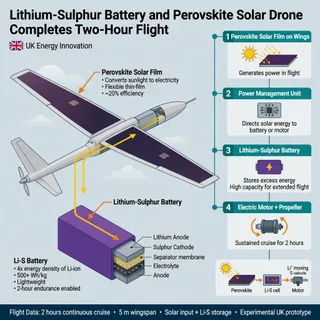
A lithium-sulphur battery drone with perovskite solar cells flew almost two hours. What the test does and does not prove for UK energy sites.
Read article
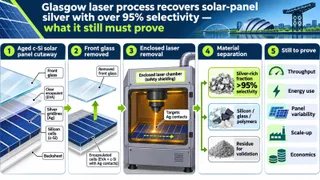
See what over 95% silver extraction selectivity means for Glasgow’s laser recycling trial and how to recycle your old solar panels in the UK.
Read article

Read article

A solar panel has two warranties: one on the hardware, a longer one on output. Here is what each covers in the UK, and what it means when one ends.
Read article



Mo's Solar Mission
Mo's Mission Nominations
Garlinge Primary School and Nursery
Garlinge Primary School and Nursery is a foundation primary school on Westfield Road in Margate, Kent, for children aged 3 to 11. It is m...
St Luke's Church of England Primary SchoolSt Luke's Church of England Primary School is a voluntary controlled Church of England primary school on Jubilee Road in Formby, Merseysi...
Comberbach Nursery and Primary SchoolComberbach Nursery and Primary School is a primary academy on Mather Drive in the village of Comberbach, near Northwich in Cheshire, for...
Locations
Solar installation near you
Write for Kilowatts.uk
Got a trade and something worth saying?
Write it here under your own name. Sign in, put a profile up, and start a guide. Pay only if you want more links from your articles out to your own site.
Register
Create a Kilowatts.uk account, or sign in if you already have one.
Author profile
Put your name, photo and experience on a public author page.
Start creating
Write a guide or a blog. Free authors can put one followed link to their own site in articles each month.
FAQ
Need Help? RoboMo's Got Answers
How does sunlight extract lithium from seawater without a membrane?
Sunlight generates a voltage at a light-sensitive electrode. That voltage lets lithium ions enter a second electrode while most sodium stays in the water. The lithium then has to be released and purified to make a usable product.
How much seawater would it take to recover one kilogram of lithium?
At a typical concentration of 0.17 milligrams per litre, about 5.9 million litres of seawater contain one kilogram of elemental lithium. That is the theoretical minimum at 100% recovery. A real system would need more water because some lithium would remain in the treated stream.
Could solar-powered lithium extraction work at commercial scale?
Researchers have demonstrated lithium capture in the laboratory, and commercial output remains unproven. A pilot would need to show how much usable lithium it can produce from a steady flow of seawater or brine. It would also need to measure how often the electrodes need cleaning or replacement and how much energy the full process uses.
Could a UK desalination plant supply brine for a trial?
An existing desalination plant could be a practical place to test the process because it already handles a concentrated saltwater stream. The operator would need to measure the lithium concentration and check how reliably the stream flows. Saltiness alone tells you little about how much lithium the brine contains.
Would the process work through a UK winter?
A UK pilot would need to measure how much light reaches the capture electrode on short or overcast days and how that affects output. Pumps, cleaning and lithium recovery would still need energy. If conventional solar panels powered any of that equipment, their winter electricity output would need a separate estimate.
Could this make home batteries cheaper in the UK?
The study gives too little evidence to predict any effect on UK home battery prices. The process would first need to produce lithium at a competitive cost and to a specification that battery supply chains can use. If you are buying a battery now, compare usable capacity, warranty and how well it fits your electricity use.
Live help
Need help right now?
Talk to RoboMo™ and get instant answers.