


27% Perovskite-Silicon Solar Panels Enter Production - What Heliene and Caelux Still Need to Prove
Published: 2026-11-23 20:09:42
Updated: 2026-11-23 12:10:49
Could Heliene and Caelux’s 27%+ perovskite-silicon tandem panels generate more on UK roofs? See how to compare annual output, durability and cost.
Overview
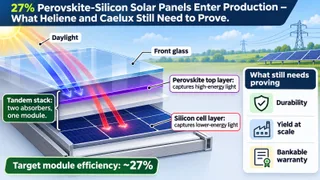
Create an unbranded technical cutaway of a perovskite–silicon tandem solar module. Show daylight entering the front glass, with a thin perovskite generating layer integrated into the glass above separate silicon cells. Use two colours to show that the perovskite absorbs some wavelengths while other light passes through to the silicon. Label the front glass, perovskite layer and silicon cells. Keep the drawing schematic and omit wiring, numerical claims, logos and watermarks.
Heliene and Caelux announce US tandem solar panel production and claim 27%+ efficiency
Heliene and Caelux say they have begun commercial-scale production of their perovskite–silicon tandem solar panel in Minnesota for the US market. Their 10 November 2026 announcement puts module efficiency at “up to 27%+”, reports an initial industrial-scale order and says deliveries are planned for 2027. A public datasheet and an independent full-module efficiency report for the exact production model could not be verified. UK availability and installed pricing remain unconfirmed.
For UK buyers with limited roof space, the question is how much extra usable electricity the panels could generate.
How the Heliene–Caelux tandem solar panel works
Caelux integrates a thin, electricity-generating perovskite layer into the front glass, above Heliene’s N-type silicon cells. As the diagram shows, the perovskite absorbs some wavelengths and lets others reach the silicon. By using different parts of the solar spectrum, the two layers can convert more of the incoming light into electricity.
Module efficiency is the share of incoming light power that the whole panel converts into DC electricity under specified test conditions. Higher efficiency means more rated watts per square metre under those conditions. To work out how much capacity fits, an installer needs the finished module’s wattage and dimensions and a scaled roof layout that accounts for roof edges, skylights, vents and shading.
What the 27%+ efficiency claim could mean for UK generation
Rated capacity in kilowatt-peak (kWp) is the array’s DC power under standard test conditions. Annual generation in kilowatt-hours (kWh) is the amount of electricity the system produces over a year. Higher module efficiency can increase the rated capacity that fits on a roof. Annual AC output depends on local sunlight, roof pitch and orientation, shading, operating temperatures and system losses.
Heliene and Caelux also say the tandem module could generate up to 20% more energy than a conventional N-type module. The announcement identifies the comparison module’s technology but leaves its make and model, the test location and the measurement period unspecified. It also leaves open whether the comparison used equal module areas and whether the gain came from outdoor measurements or modelling.
Ask for annual AC generation estimates for two named models on the same usable roof area. The estimates should use the same shading and weather assumptions and show any losses from inverter clipping or curtailment due to an export limit.
Where tandem panels could make sense in the UK
The strongest case is a roof with limited usable space where the extra electricity can be used on site or exported at a worthwhile rate. Panel dimensions can decide the result. If tandem modules leave an awkward gap around a chimney or skylight, smaller silicon modules may fit more rated capacity on the roof.
Overview
For a balcony solar installation, the module would need to be part of a system designed for that mounting position and electrical connection. On a commercial roof, check the roof’s condition and remaining service life before comparing commercial solar layouts. If the roof needs work during the array’s life, removing and reinstalling panels can affect the economics.
What Heliene and Caelux still need to prove
Ask for a production datasheet with the exact model identifier, rated power, external dimensions and electrical characteristics. An independent full-module efficiency report should identify the same model and give the measured power, the area used to calculate efficiency and the test conditions. Outdoor results against a named silicon module should identify the site, give the dates and explain how the outputs were compared. Data from different seasons would help buyers judge how the gain might translate to a UK roof.
For durability, ask for outdoor degradation data and damp-heat and thermal-cycling results for the same module construction. Accelerated tests show how the design copes with particular stresses. Field data show how its output changes in service. Check what the product warranty covers, how much power the performance warranty promises over time and who handles UK claims. Get written confirmation of who pays for access, including scaffolding, and for the labour to remove and replace panels.
UK installers need the module’s weight, dimensions and permitted clamp positions to assess the roof and design the mounting system. They also need wiring instructions and electrical ratings to check cold-weather string voltage and inverter input limits. Ask for solar panel certification evidence for the exact model where applicable. Have the installer confirm the network connection route for the proposed inverter, export arrangement and any battery.
How to compare costs before deciding whether to wait
Start with an itemised quote for conventional solar that shows a scaled roof layout, estimated annual AC generation and how much electricity you could use on site or export. When a UK tandem quote becomes available, compare the full installed costs, including access, mounting and electrical work. Work out what the extra generation would be worth each year. Use the avoided import rate for electricity you use on site and the applicable export rate for electricity you send to the grid. If the design includes storage, use the same battery assumptions for both quotes and account for charging and discharging losses.
If a conventional array fits and meets your needs, you have a design you can price now. If the layout already uses all the available roof space and you expect your daytime electricity use to rise, keep the layout and generation estimate. Use them to judge whether the extra output is worth the higher installed cost once you can verify UK supply, performance for the quoted model and warranty support.
Solar comparison
Compare solar for your property
Enter your postcode to assess your roof, compare solar options and get quotes from UK installers.
- Free postcode start
- Home, business and industrial
- RoboMo™ maps your roof
See which panels fit your roof
Choose home, business or industrial, then enter your postcode. RoboMo maps the roof and ranks panel brands by fit.
1. Postcode Start the assessment for your property.
2. Pin the roof Mark the array on the map.
3. Compare RoboMo™ builds your options.

Battery ROI tool
See what a battery saves on your bill
Enter the day rate, off-peak rate and export rate. The calculator ranks batteries in the Kilowatts shop over 10 years. Home batteries also suit offices and small commercial sites.
Reading
Sources and further reading
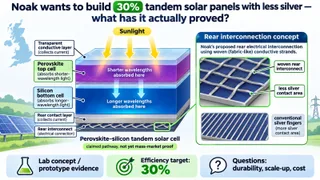
See what Noak’s tandem solar tests reveal, why 30% panel efficiency and silver savings remain unproven, and what UK buyers can compare today.
Read article
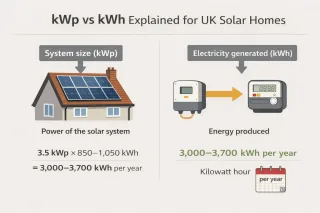
Understand solar panel output uk in the UK, with clear explanations, examples, and practical next steps.
Read article

Solar panels want light, not heat. Here's why rising cell temperature cuts voltage and output, and why a cold bright British morning can beat a hot afternoon.
Read article
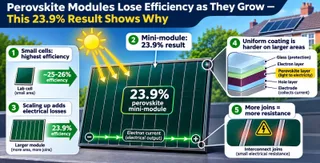
See how cooling preserved fill factor in a certified 23.9% perovskite mini-module and what UK buyers should check when comparing full-size solar panels.
Read article


Mo's Solar Mission
Mo's Mission Nominations
Garlinge Primary School and Nursery
Garlinge Primary School and Nursery is a foundation primary school on Westfield Road in Margate, Kent, for children aged 3 to 11. It is m...
St Luke's Church of England Primary SchoolSt Luke's Church of England Primary School is a voluntary controlled Church of England primary school on Jubilee Road in Formby, Merseysi...
Comberbach Nursery and Primary SchoolComberbach Nursery and Primary School is a primary academy on Mather Drive in the village of Comberbach, near Northwich in Cheshire, for...
Locations
Solar installation near you
Write for Kilowatts.uk
Got a trade and something worth saying?
Write it here under your own name. Sign in, put a profile up, and start a guide. Pay only if you want more links from your articles out to your own site.
Register
Create a Kilowatts.uk account, or sign in if you already have one.
Author profile
Put your name, photo and experience on a public author page.
Start creating
Write a guide or a blog. Free authors can put one followed link to their own site in articles each month.
FAQ
Need Help? RoboMo's Got Answers
Can I buy Heliene–Caelux tandem solar panels in the UK?
The companies announced production in Minnesota for the US market, with deliveries planned for 2027. UK availability and installed pricing remain unconfirmed. If a supplier offers the panels, ask for the exact model, a delivery date and details of who would handle warranty claims in the UK.
What does 27%+ efficiency mean for my roof?
Module efficiency is the share of incoming light power that a panel converts into electricity under specified test conditions. A more efficient panel can fit more rated power into the same area, though panel dimensions determine how many will fit around chimneys and skylights. The 27%+ figure is a manufacturer claim, and the article could not verify an independent full-module test report for the exact production model.
Will these tandem panels generate 20% more electricity on a UK roof?
The companies claim up to 20% more energy than a conventional N-type silicon module. Their announcement leaves the comparison model, test location and measurement period unspecified. Ask your installer to compare annual generation in kWh for two named models on the same usable roof area, using the same weather and shading assumptions and accounting for inverter and export limits.
What evidence should I ask for before buying tandem panels?
Ask for a datasheet and an independent full-module efficiency report that identify the exact model you are being quoted. The report should state the measured power, the area used to calculate efficiency and the test conditions. For the claimed energy gain, ask for outdoor results against a named silicon panel, with the site, dates and comparison method.
How can I judge how long tandem solar panels will last?
Ask for outdoor degradation data and damp-heat and thermal-cycling results for the same module construction. Accelerated tests show how the design handles particular stresses, while outdoor data show how its output changes in service. Check the product and performance warranties, including who handles UK claims and who pays for scaffolding and replacement labour.
Can tandem panels use standard solar mounting and inverters?
Compatibility depends on the exact panel and system design. Your installer needs the module’s size, weight and permitted clamp positions to check the mounting, and its electrical ratings to check cold-weather string voltage and inverter limits. Ask the installer to confirm any applicable certification for the quoted model and the network connection route for the proposed system.
Should I wait for tandem panels or install conventional solar now?
Start with an itemised conventional solar quote that includes a scaled roof layout and an annual generation estimate. If that design meets your needs, you have a system you can price now. If roof space limits the design, use the quote as a baseline when UK tandem prices become available. Compare the extra installed cost with the value of the extra electricity you expect to use at home or export.
Live help
Need help right now?
Talk to RoboMo™ and get instant answers.