


Perovskite Modules Lose Efficiency as They Grow - This 23.9% Result Shows Why
Published: 2026-11-24 13:40:07
Updated: 2026-11-24 05:40:52
See how cooling preserved fill factor in a certified 23.9% perovskite mini-module and what UK buyers should check when comparing full-size solar panels.
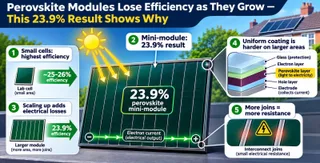
Why perovskite modules lose efficiency as they grow and what a 23.9% mini-module shows
Perovskite modules can lose efficiency as they grow because their fill factor falls, reducing the power they deliver under load. In a *Nature Communications* study, cooling the wet perovskite film during manufacture helped limit that loss. A cooled mini-module achieved a certified steady-state efficiency of 23.9% over a 19.48 cm² aperture, with a fill factor of 83.3%. In a separate test at the same aperture, the 15 cooled mini-modules had higher measured efficiencies and a narrower spread of results than the 15 conventionally processed controls. Nature Communications study, Figure 5
Steady-state efficiency is the share of incoming light power converted into electrical power once the output has stabilised under test conditions. The aperture is the area exposed to light during the test. When comparing this result with a commercial datasheet, check which area the manufacturer uses to calculate efficiency. The panel’s full footprint includes its borders and any other space it takes up on the roof.
Why fill factor falls as perovskite devices get larger
Fill factor is the maximum electrical power divided by the product of the open-circuit voltage and short-circuit current. At open circuit, no current flows. At short circuit, the voltage is zero. The module delivers power between those two conditions. If it supplies less current at its operating voltages, its maximum power and fill factor fall.
Variations in film quality across a larger coated area can make interconnected cells behave unevenly. Resistance in the conductive layers and interconnections can also dissipate power. The researchers identified falling fill factor as a major contributor to efficiency loss during scale-up, even when the film already absorbs light well. Study analysis of scale-up losses
How controlled cooling helped preserve fill factor
The researchers cooled the freshly deposited film during manufacture. This changed how a temporary material phase developed as the perovskite crystallised. They attributed most of the fill-factor improvement to the finished device behaving more like an ideal diode. Study findings on cryo-controlled processing
Using the same aperture helped isolate the effect of processing from the effect of device size. The narrower spread suggests the cooling process gave more consistent results within the test groups. The next question is whether the process can deliver similar gains on full-size panels and across production batches. Assessing outdoor service life requires tests on finished, sealed modules exposed to moisture, sunlight and repeated temperature changes.
What the result tells UK buyers about solar output and cost
The mini-module test measured conversion efficiency in the laboratory. Estimating annual generation in the UK requires a full-size module specification and a design for the site. Energy Saving Trust gives around £7,600 as a guide for a typical 4.5 kWp domestic rooftop installation. Roof access, mounting and any remedial work can change the quote. Energy Saving Trust solar panel cost guide
If roof space is limited, ask how much rated capacity the proposed layout can accommodate, measured in kilowatt-peak (kWp). Compare annual generation estimates in kilowatt-hours (kWh) using the same assumptions about location, orientation, pitch, shading and system losses. Higher-efficiency panels can fit more capacity into the available area. The dimensions of the exact model determine how many will fit around chimneys and rooflights. Ask for a drawing and a generation estimate based on that layout. Energy Saving Trust rooftop solar installation guide
What to check for a roof, balcony or business premises
Higher panel efficiency is most useful when the amount of well-lit space limits the installation. On a shaded balcony, the hours of direct sunlight may matter more. At a business with low daytime demand and limited export capacity, the value of extra generation depends on how much the business can use or export.
Overview
Before ordering plug-in balcony solar, check the rules for your nation. Energy Saving Trust’s guidance distinguishes Great Britain, where qualifying devices can be used, from Northern Ireland, which has separate regulations. In England, Scotland or Wales, check the exact make and model against the Energy Networks Association’s approved product list and complete the required registration before use. Check who can approve the mounting under your tenancy or lease. This could be your landlord or freeholder, or a building manager authorised to act on their behalf. Energy Saving Trust plug-in solar guide
When comparing solar for your business or farm, ask how much electricity the system is expected to generate each year, how much you can use on site and how much you can export. If an export limit applies, check whether the forecast allows for the system cutting its output when site demand is low.
What would make a perovskite panel worth specifying?
Ask for the datasheet for the exact full-size module. Check its dimensions, rated output and the area used to calculate efficiency. Look for outdoor performance evidence for that model and check what the product and performance warranties cover, who honours them and how to make a claim. If a supplier claims MCS certification, match the manufacturer and full model number on the quote against the official MCS Product Directory. The study’s efficiency certificate covers the tested mini-module.
If you’re weighing up solar for home, give each shortlisted installer the same site details and electricity-use data. Ask for a panel layout, a generation estimate with its assumptions and an itemised installed price. Use those figures to judge whether a higher-efficiency module will add enough usable generation on your site to justify any price difference.
Solar comparison
Compare solar for your property
Enter your postcode to assess your roof, compare solar options and get quotes from UK installers.
- Free postcode start
- Home, business and industrial
- RoboMo™ maps your roof
See which panels fit your roof
Choose home, business or industrial, then enter your postcode. RoboMo maps the roof and ranks panel brands by fit.
1. Postcode Start the assessment for your property.
2. Pin the roof Mark the array on the map.
3. Compare RoboMo™ builds your options.

Battery ROI tool
See what a battery saves on your bill
Enter the day rate, off-peak rate and export rate. The calculator ranks batteries in the Kilowatts shop over 10 years. Home batteries also suit offices and small commercial sites.
Reading
Sources and further reading
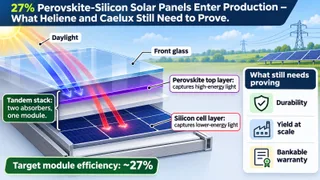
Could Heliene and Caelux’s 27%+ perovskite-silicon tandem panels generate more on UK roofs? See how to compare annual output, durability and cost.
Read article
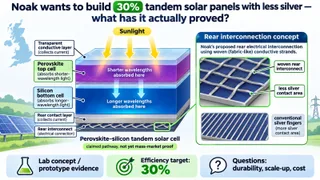
See what Noak’s tandem solar tests reveal, why 30% panel efficiency and silver savings remain unproven, and what UK buyers can compare today.
Read article

A peer-reviewed study reports a certified 23.9% perovskite mini-module. Understand its 19.48 cm2 test area and the gap between a lab result and roof panels.
Read article
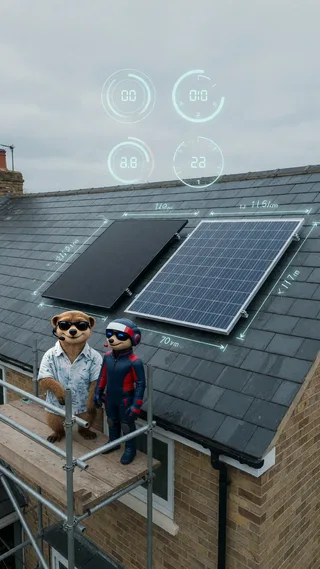
Two panels with the same wattage produce the same power. Here's what solar panel efficiency really changes on a UK roof - and when it's worth paying for.
Read article



Mo's Solar Mission
Mo's Mission Nominations
Garlinge Primary School and Nursery
Garlinge Primary School and Nursery is a foundation primary school on Westfield Road in Margate, Kent, for children aged 3 to 11. It is m...
St Luke's Church of England Primary SchoolSt Luke's Church of England Primary School is a voluntary controlled Church of England primary school on Jubilee Road in Formby, Merseysi...
Comberbach Nursery and Primary SchoolComberbach Nursery and Primary School is a primary academy on Mather Drive in the village of Comberbach, near Northwich in Cheshire, for...
Locations
Solar installation near you
Write for Kilowatts.uk
Got a trade and something worth saying?
Write it here under your own name. Sign in, put a profile up, and start a guide. Pay only if you want more links from your articles out to your own site.
Register
Create a Kilowatts.uk account, or sign in if you already have one.
Author profile
Put your name, photo and experience on a public author page.
Start creating
Write a guide or a blog. Free authors can put one followed link to their own site in articles each month.
FAQ
Need Help? RoboMo's Got Answers
What does the 23.9% perovskite result mean?
The tested mini-module converted 23.9% of the light power falling on its 19.48 cm² test area into electricity once its output had stabilised. The researchers reported a certified efficiency for that device. A comparison with a full-size rooftop panel should account for which area each efficiency figure uses.
Why can perovskite modules lose efficiency as they get larger?
Coating a larger area evenly is harder, and variations in the film can make interconnected cells perform unevenly. Electrical resistance in the module can also waste some power. These losses can lower the fill factor, which reflects how much usable power the module delivers relative to its maximum voltage and current measured separately.
Would perovskite panels need cooling on my roof?
The researchers cooled the wet perovskite film during manufacture. Mini-modules made this way performed better and showed less variation than conventionally processed modules of the same test size. The study leaves open whether the same gains can be achieved on full-size panels in production.
Will higher-efficiency panels generate more electricity on my roof?
Higher-efficiency panels can fit more rated capacity into a limited area. The benefit depends on the dimensions of the exact panels and how many fit around features such as chimneys and rooflights. Ask installers for a roof layout, the total capacity in kWp and estimated annual generation in kWh using comparable assumptions about shade, orientation and system losses.
How can I tell whether higher-efficiency panels are worth paying more for?
Ask each installer for an itemised installed price and a generation estimate based on the proposed roof layout. Check what each quote includes, such as scaffolding and any electrical work identified during the survey. Weigh any price difference against the extra electricity you expect to use at home or export.
What should I check if an installer quotes for a perovskite panel?
Ask for the exact full-size model’s datasheet and outdoor performance evidence. Check its dimensions, rated output, what the product and performance warranties cover, and who handles claims. If the supplier claims MCS certification, match the manufacturer and full model number against the MCS Product Directory.
Is higher panel efficiency worth prioritising for balcony solar?
Start by checking when direct sunlight reaches the proposed panel position, since shade from the balcony above or nearby buildings can limit output. Check that the mounting is suitable for the site and who can approve it under your tenancy or lease. Before buying a plug-in system, check the connection requirements for the exact model where you live.
Live help
Need help right now?
Talk to RoboMo™ and get instant answers.