LinkedIn profile for David Coleman David Coleman
Founder & Renewable Energy Author, kilowatts.uk

LinkedIn profile for David Coleman David Coleman
Founder & Renewable Energy Author, kilowatts.uk
Article
A peer-reviewed study reports a certified 23.9% perovskite mini-module. Understand its 19.48 cm2 test area and the gap between a lab result and roof panels.
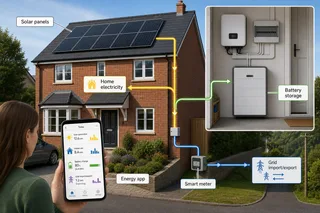
Illustration of a home energy system; it does not depict a product or installation announced in this article.
Published 5 November 2026. Research published in Nature Communications on 29 October 2026; DOI 10.1038/s41467-026-78867-1.
A perovskite mini-module achieved certified steady-state efficiency of 23.9% in a peer-reviewed study. Its aperture area was 19.48 cm2. This is a research result on a small module, rather than a full-size roof panel offered to UK households.
The finding concerns what happens when a promising device gets bigger: preserving the electrical performance called fill factor can help reduce efficiency lost during scale-up.
The Nature Communications paper analyses efficiency losses across device scales. It identifies fill factor as a major constraint and reports cryo-controlled processing that regulates an intermediate phase during crystallisation.
The mini-module has an 83.3% fill factor. That is not its percentage conversion of sunlight to electricity: efficiency and fill factor describe different aspects of performance.
A small-device result does not simply multiply with area. A larger module must maintain consistent materials, electrical connections and current collection. A successful sample still needs a route to repeatable manufacturing.
A UK customer buys finished modules and an installation layout. A strong research result can point towards better products without establishing their wattage, price or service life.
Certification is useful evidence about the tested device. Read it with the area and test conditions. It does not measure annual production on a British roof or provide a long-term warranty.
Likewise, a link between performance loss and operational decay does not replace years of outdoor testing on production modules. Reliability evidence must suit the conditions and timescale being claimed.
Look for consistent larger modules, independent durability evidence, electrical specifications, system compatibility, certification and support. A practical process must also deliver saleable panels at an acceptable manufacturing cost.
Cooling and other processing steps need to work within that production process. Demonstrating a scientific mechanism does not by itself establish factory throughput or commercial economics.
Keep the work on a watch list while comparing available systems on documented specifications. On a constrained roof, usable area and layout matter alongside efficiency. Ask for an output estimate with its assumptions rather than inserting a laboratory percentage into household savings.
This study addresses performance retention during scale-up. Its commercial significance will depend on transfer into larger, durable and consistently manufactured products.
Solar comparison
Enter your postcode to assess your roof, compare solar options and get quotes from UK installers.
Choose home, business or industrial, then enter your postcode. RoboMo maps the roof and ranks panel brands by fit.
1. Postcode Start the assessment for your property.
2. Pin the roof Mark the array on the map.
3. Compare RoboMo™ builds your options.
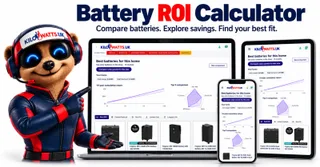
Battery ROI tool
Enter the day rate, off-peak rate and export rate. The calculator ranks batteries in the Kilowatts shop over 10 years. Home batteries also suit offices and small commercial sites.
Reading
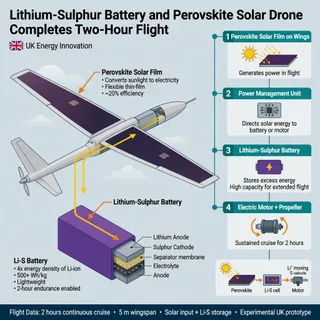
A lithium-sulphur battery drone with perovskite solar cells flew almost two hours. What the test does and does not prove for UK energy sites.
Read article

A 650W solar panel is a large high-output module. It can mean fewer panels, but it is often too big for a typical UK home roof.
Read article
Noak has raised EUR5 million to develop perovskite-silicon tandem solar. What the European spinout means for UK buyers, and what remains unproven.
Read article
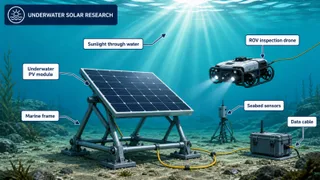
Underwater solar panels can work when enough sunlight reaches them. A recent perovskite solar cell study shows useful prototype output at 10 metres depth.
Read article
Write for Kilowatts.uk
Write it here under your own name. Sign in, put a profile up, and start a guide. Pay only if you want more links from your articles out to your own site.
Create a Kilowatts.uk account, or sign in if you already have one.
Put your name, photo and experience on a public author page.
Write a guide or a blog. Free authors can put one followed link to their own site in articles each month.
FAQ
Live help
Talk to RoboMo™ and get instant answers.
Live chat