


Oxford-Monash Team Finds Hidden Polar Walls Inside a Perovskite Solar Material
Published: 2026-11-23 21:37:59
Updated: 2026-11-23 13:38:43
See how Oxford and Monash found polar twin walls four atomic layers wide in a perovskite film, and why solar cell efficiency gains remain unproven.
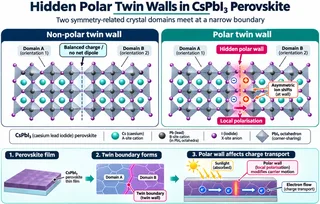
What the Oxford–Monash team saw inside a perovskite film
Researchers from the University of Oxford and Monash University found polar twin walls in thin films of caesium lead iodide (CsPbI₃), a material studied for use in perovskite solar cells. Using low-dose scanning transmission electron microscopy, they saw lead atoms shift at one type of crystal boundary, creating local electrical polarisation within an otherwise non-polar crystal. Whether this affects the efficiency of a working solar cell remains unknown. Li et al., *Polarized twin walls in a halide perovskite*, PNAS (2026)
What makes a twin wall electrically polar?
A twin wall is a boundary between two regions of the same crystal whose atomic arrangements are related by symmetry. At walls parallel to the {110} crystal planes, lead atoms shifted off-centre in a consistent direction, breaking the local symmetry and creating polarisation. At the {112} walls, the researchers found no comparable polar shift of lead. They observed less tilting of the lead–iodide structures and smaller off-centre shifts of caesium atoms. PNAS study via the Oxford Research Archive
The team kept the electron dose low to limit damage to the film while imaging its atomic structure. At a polar wall, lead atoms shifted by up to about 15 picometres. The polar region extended across about four atomic layers, and the polar walls were roughly 30–50 nanometres apart in the films studied. PNAS study via the Oxford Research Archive and Monash University research release
The atomic shift shows local polarisation at the {110} wall. To establish ferroelectricity, a further experiment would need to show that an applied electric field can reverse that polarisation.
Could polar twin walls make solar cells more efficient?
Polar twin walls could affect how electrical charges move through a solar cell. When a cell absorbs light, it generates electrons and holes. The cell produces useful current when its contacts collect those charges before they recombine. A polar wall could change their paths and affect how much charge reaches the contacts.
Researchers could test this by comparing otherwise similar cells with different wall densities or orientations. Measuring charge collection alongside power conversion efficiency would show whether changes in the film affect the cell’s output. Any repeatable gain would then need to carry over to full-size modules and persist under outdoor operating conditions.
What should UK homes, businesses and farms compare now?
The thin-film findings leave the usual criteria for comparing solar quotes in place. For a home, business or farm, start with the proposed layout, the estimated annual generation and how much of that electricity the site can use.
On a small or awkward roof, ask each installer for a layout showing how many modules fit around rooflights, chimneys and other obstructions. Kilowatts peak (kWp) express the array’s rated power under standard test conditions. Kilowatt-hours (kWh) measure the energy it is expected to generate over a period, such as a year. Ask for the module model and the assumptions behind the annual kWh estimate, especially if trees or nearby buildings shade part of the roof. Check that quotes use the same roof faces, pitch and shading assumptions before comparing the estimates. Energy Saving Trust solar panel guide
For balcony solar, check when direct sunlight reaches the proposed mounting position. The balcony above, side walls and balustrade can shade the panel even when the building faces the sun. If you are considering a plug-in system, check what permissions you need from the landlord, freeholder or building manager before buying. Confirm that the mounting can withstand wind exposure and that the socket and circuit are suitable. If you are unsure about the wiring, ask a qualified electrician to check it. Energy Saving Trust plug-in solar checklist For a business or farm, ask the installer to compare forecast generation with half-hourly electricity use if you have those data. A site that runs refrigeration during the day can use a different share of its solar generation from a site with similar roof space that runs most equipment after dark. Ask for separate estimates of electricity used on site and exported to the grid. Compare the warranties for the modules, inverter and workmanship individually. Use those estimates and warranty terms when comparing solar options for businesses. Use the Kilowatts UK solar tools for an initial generation estimate and the installer directory to find someone who can survey the site. If you’re planning a home installation, you can compare rooftop solar options. Ask each installer to explain which assumptions have the biggest effect on annual generation and on-site use.
Solar comparison
Compare solar for your property
Enter your postcode to assess your roof, compare solar options and get quotes from UK installers.
- Free postcode start
- Home, business and industrial
- RoboMo™ maps your roof
See which panels fit your roof
Choose home, business or industrial, then enter your postcode. RoboMo maps the roof and ranks panel brands by fit.
1. Postcode Start the assessment for your property.
2. Pin the roof Mark the array on the map.
3. Compare RoboMo™ builds your options.

Battery ROI tool
See what a battery saves on your bill
Enter the day rate, off-peak rate and export rate. The calculator ranks batteries in the Kilowatts shop over 10 years. Home batteries also suit offices and small commercial sites.
Reading
Sources and further reading
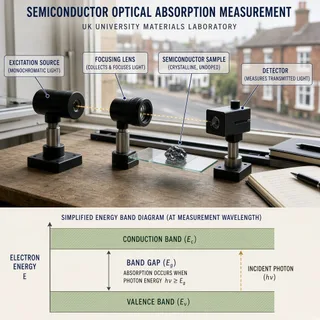
Oxford's pseudo-direct semiconductor work is not a UK roof product. The 75% Bi2S3 figure is recombination suppression, not module efficiency.
Read article
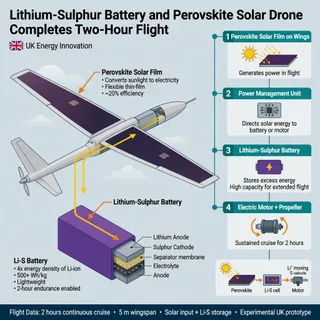
A lithium-sulphur battery drone with perovskite solar cells flew almost two hours. What the test does and does not prove for UK energy sites.
Read article

A peer-reviewed study reports a certified 23.9% perovskite mini-module. Understand its 19.48 cm2 test area and the gap between a lab result and roof panels.
Read article
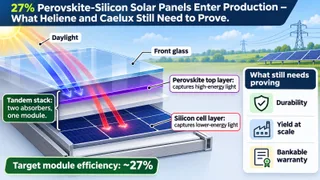
Could Heliene and Caelux’s 27%+ perovskite-silicon tandem panels generate more on UK roofs? See how to compare annual output, durability and cost.
Read article



Mo's Solar Mission
Mo's Mission Nominations
Garlinge Primary School and Nursery
Garlinge Primary School and Nursery is a foundation primary school on Westfield Road in Margate, Kent, for children aged 3 to 11. It is m...
St Luke's Church of England Primary SchoolSt Luke's Church of England Primary School is a voluntary controlled Church of England primary school on Jubilee Road in Formby, Merseysi...
Comberbach Nursery and Primary SchoolComberbach Nursery and Primary School is a primary academy on Mather Drive in the village of Comberbach, near Northwich in Cheshire, for...
Locations
Solar installation near you
Write for Kilowatts.uk
Got a trade and something worth saying?
Write it here under your own name. Sign in, put a profile up, and start a guide. Pay only if you want more links from your articles out to your own site.
Register
Create a Kilowatts.uk account, or sign in if you already have one.
Author profile
Put your name, photo and experience on a public author page.
Start creating
Write a guide or a blog. Free authors can put one followed link to their own site in articles each month.
FAQ
Need Help? RoboMo's Got Answers
What did the Oxford–Monash team discover?
The researchers found electrically polar boundaries, called twin walls, inside thin films of caesium lead iodide. At one type of boundary, lead atoms shifted off-centre in a consistent direction. This created local electrical polarisation across a few atomic layers.
Could polar twin walls make solar panels more efficient?
The walls could affect how electrical charges move through a solar cell. The study did not establish whether that helps or hinders charge collection in a working cell. Any efficiency gain would need to be demonstrated in cells and then confirmed in full-size panels under outdoor conditions.
Should I wait for perovskite panels before installing solar?
This study alone gives buyers little reason to delay an installation. If you are comparing quotes now, ask for the exact panel model, estimated annual generation and warranty terms. Use those details to judge how well each proposal fits your roof and electricity use.
How should I compare solar quotes if my roof is small or shaded?
Ask each installer for a layout showing how many panels fit around chimneys, rooflights and other obstructions. Compare expected annual generation using the same roof faces, pitch and shading assumptions. The kWp figure gives the system’s rated power, while annual kWh estimates how much electricity it will generate over a year.
What should I check before buying a balcony solar panel?
Check when direct sunlight reaches the proposed mounting position, as the balcony above and the balustrade can cast shade. Ask your landlord, freeholder or building manager which permissions apply, and confirm that the mounting is suitable for the site’s wind exposure. If you are considering a plug-in system and are unsure about the socket or circuit, ask a qualified electrician to check it.
What should a business or farm ask for in a solar quote?
Ask the installer to compare forecast solar generation with your half-hourly electricity use if those data are available. Request separate estimates for electricity used on site and electricity exported to the grid. Check the terms of the panel, inverter and workmanship warranties individually.
Live help
Need help right now?
Talk to RoboMo™ and get instant answers.