


Renewables Obligation Fixed Price Certificates: Who Wins Under the UK Plan?
Published: 2026-11-24 09:46:34
Updated: 2026-11-24 01:47:39
See how UK Renewables Obligation fixed-price certificates would replace ROC trading and what the switch could mean for generator income and bills.
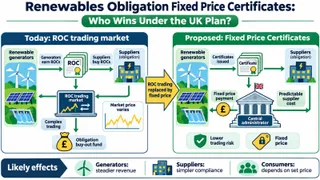
Renewables Obligation Fixed Price Certificates and who stands to gain
Existing accredited renewable generators that sell certificates at variable prices stand to gain the most price certainty under the UK’s proposed Renewables Obligation Fixed Price Certificates (FPC) system. A central administrator would buy certificates for eligible generation at a set price each scheme year, replacing trading in Renewables Obligation Certificates (ROCs). Whether generators earn more depends on the final price and what they receive under their current contracts. Suppliers would fund the purchases through a levy. The effect on household bills would depend on scheme costs and how suppliers recover them. Department for Energy Security and Net Zero consultation
The consultation opened on 3 November 2026 and closes on 12 January 2027. The earliest proposed start is 1 April 2028, the first day of the 2028/29 scheme year. The proposal covers the Renewables Obligation schemes in England and Wales, Scotland, and Northern Ireland. Consultation scope and timetable
How fixed-price certificates would replace ROC trading
Ofgem issues ROCs to accredited generators for eligible renewable electricity. Generators can sell them directly to electricity suppliers or through intermediaries. Suppliers meet their obligation by presenting ROCs, paying into a buy-out fund, or doing both. Ofgem redistributes the fund to suppliers in proportion to the ROCs they present. Both the buy-out price and the expected share of the fund influence what buyers will pay for a ROC. Ofgem’s Renewables Obligation overview
Under the proposal, a central administrator would verify eligible generation, issue certificates and buy them at the set price. Most generators would receive monthly payments in arrears once the administrator had checked their claims and issued the certificates. Eligible microgenerators with a capacity of 50 kW or less could continue to report annually, which may suit sites that take readings manually. Proposed generator payment schedule
Who benefits and who carries the transition costs?
Generators exposed to variable ROC prices could forecast certificate income more easily as the trading market shrinks. Sites with a fixed or protected ROC price under a power purchase agreement (PPA) may benefit less. In either case, check the net amount received per certificate, when payments arrive and which contract terms apply if the support scheme changes.
Overview
The Department for Energy Security and Net Zero (DESNZ) proposes quarterly levy payments in advance, with later reconciliation and special arrangements for the first year. Suppliers could have to fund the new levy while still paying final ROC settlement costs. The effect on an individual bill depends on the final scheme costs and how the supplier recovers them. For context, see what makes up electricity prices. Proposed supplier levy payment schedule
What would each certificate be worth?
DESNZ proposes taking the buy-out price from the final year of the existing ROC scheme and adjusting it for Consumer Prices Index (CPI) inflation. If the switch starts in April 2028, the final ROC scheme year would be 2027/28. Ofgem’s buy-out price for 2026/27 is £69.34, the amount a supplier pays for each ROC it is short that year. The first FPC price remains undecided. Ofgem’s 2026/27 buy-out price · DESNZ proposal for the starting price
The modelling annex tests the buy-out price with no uplift and with uplifts of 2%, 5%, 8% and 10%. An uplift could reflect some of the value that redistribution from the buy-out fund adds to ROC prices today. To see what each scenario would mean for your site, compare the modelled price with what you receive per ROC after deducting fees and including any share of the redistributed funds passed on under your contract. DESNZ modelling of certificate price uplifts
Annual certificate income would still vary with eligible generation. The proposal carries over existing accreditation periods and banding. The band determines how many certificates a station earns per megawatt-hour (MWh) of eligible output. To estimate the number of certificates, multiply eligible metered generation in MWh by the station’s accredited rate. The equipment rating in kilowatts describes its power capacity. Solar specifications often express this as a peak power rating in kWp. Track income from electricity sales and export separately.
What owners of accredited sites should check now
Start with the station’s accreditation record, generation submissions and latest contract or agent statement. Check who submits meter readings, who holds issued but unsold ROCs and who receives the proceeds. If your PPA bundles electricity and ROCs, ask the counterparty to show each payment separately and point out the terms that apply if the support scheme changes. Use actual payment dates in your cash-flow comparison, including any share of redistributed funds that arrives after the initial payment. For background on the electricity side of the contract, see how solar PPAs work.
The transition proposal could cover eligible ROCs that Ofgem has yet to issue and ROCs that remain unsold because they arrived late or there was no buyer. In the consultation’s illustrative timetable, FPCs start on 1 April 2028 and the final ROC compliance deadline is 1 September 2028. The proposal considers ROCs still unissued or unredeemed at that deadline. It excludes ROCs held by suppliers that have already paid the generator in full and have no agreement to share redistributed funds. The administrator would buy eligible transitional ROCs at the buy-out price for the year the electricity was generated. Holders would have 25 months after the month of issue to present them for purchase. DESNZ proposals for outstanding ROCs at transition
Record the generation month, claim status and any issue date for each outstanding batch so you can check it against the final rules. Keep any expected transition payment separate in your cash-flow forecast until you can confirm eligibility and timing. If you plan to replace an inverter, change metering or add capacity, check how the work would affect the accredited station’s metering and reporting before committing to a design.
What this means for new UK solar installations
Leave FPC income out of the financial forecast for a new home, farm or business solar installation. The Renewables Obligation closed to all new generating capacity on 1 April 2017. The proposal changes how existing accredited generation is paid. If you already receive Feed-in Tariff or export payments, check the scheme name on your statement to see which arrangements apply. Ofgem’s Renewables Obligation overview
Ask installers to show how roof orientation and shading affect their generation forecasts. Compare when the panels are expected to generate with when the property uses electricity. A quote should show the value of electricity used on site separately from expected export income. Use the same consumption and tariff assumptions across quotes so you can see which differences come from the system design. If you’re planning a business installation, use those assumptions when you compare commercial solar installations.
Solar comparison
Compare solar for your property
Enter your postcode to assess your roof, compare solar options and get quotes from UK installers.
- Free postcode start
- Home, business and industrial
- RoboMo™ maps your roof
See which panels fit your roof
Choose home, business or industrial, then enter your postcode. RoboMo maps the roof and ranks panel brands by fit.
1. Postcode Start the assessment for your property.
2. Pin the roof Mark the array on the map.
3. Compare RoboMo™ builds your options.

Battery ROI tool
See what a battery saves on your bill
Enter the day rate, off-peak rate and export rate. The calculator ranks batteries in the Kilowatts shop over 10 years. Home batteries also suit offices and small commercial sites.
Reading
Sources and further reading

A UK consultation proposes Fixed Price Certificates for the Renewables Obligation. See the timetable, who is affected and why household savings are uncertain.
Read article
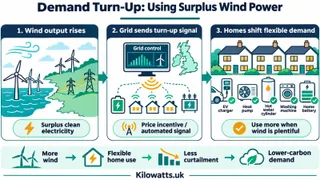
See how the UK demand turn-up trial will test electricity discounts when wind power is surplus, and when shifting EV charging could cut your bill.
Read article
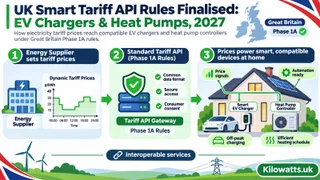
See how Great Britain’s smart tariff API can help EV chargers and heat pumps run in cheaper hours, and what to check before buying kit or switching tariff.
Read article
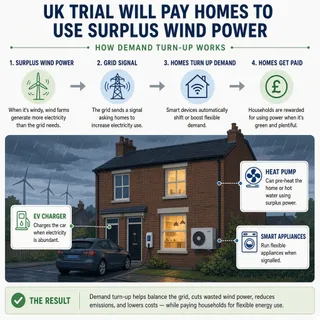
The UK Demand Turn-Up trial will not pay every home to use surplus wind power, and it is not free electricity.
Read article



Mo's Solar Mission
Mo's Mission Nominations
Garlinge Primary School and Nursery
Garlinge Primary School and Nursery is a foundation primary school on Westfield Road in Margate, Kent, for children aged 3 to 11. It is m...
St Luke's Church of England Primary SchoolSt Luke's Church of England Primary School is a voluntary controlled Church of England primary school on Jubilee Road in Formby, Merseysi...
Comberbach Nursery and Primary SchoolComberbach Nursery and Primary School is a primary academy on Mather Drive in the village of Comberbach, near Northwich in Cheshire, for...
Locations
Solar installation near you
Write for Kilowatts.uk
Got a trade and something worth saying?
Write it here under your own name. Sign in, put a profile up, and start a guide. Pay only if you want more links from your articles out to your own site.
Register
Create a Kilowatts.uk account, or sign in if you already have one.
Author profile
Put your name, photo and experience on a public author page.
Start creating
Write a guide or a blog. Free authors can put one followed link to their own site in articles each month.
FAQ
Need Help? RoboMo's Got Answers
What are Renewables Obligation Fixed Price Certificates, and when could they start?
Under the proposal, a central administrator would buy certificates from eligible accredited generators at a set price for each scheme year. This would replace trading in Renewables Obligation Certificates (ROCs). The earliest proposed start date is 1 April 2028.
Who stands to gain most from fixed-price certificates?
Accredited generators currently selling ROCs at variable prices could gain the most certainty over what they receive per certificate. Owners whose contracts already fix or protect their ROC price may see less benefit. Whether either group earns more depends on the final certificate price and what they currently receive after fees.
How much would each fixed-price certificate be worth?
The first certificate price has yet to be decided. The government proposes using the final ROC scheme year's buy-out price as a starting point and adjusting it for inflation. It has also modelled several possible uplifts. Your total certificate income would still depend on how much eligible electricity your installation generates and how many certificates it earns per unit.
Could fixed-price certificates change my electricity bill?
Suppliers would fund certificate purchases through a levy. Any effect on your bill would depend on the final cost of the scheme and how your supplier recovers that cost through its tariffs. The proposal gives no firm basis for predicting how much an individual household's bill might change.
Can I get fixed-price certificates for new solar panels?
The proposal applies to existing generation accredited under the Renewables Obligation, which closed to all new generating capacity on 1 April 2017. For a new solar installation, base your financial forecast on expected savings from using the electricity you generate and any export income. Ask installers to show those figures separately so you can compare quotes.
Would the proposal affect my Feed-in Tariff or solar export payments?
The proposal changes payments for generation accredited under the Renewables Obligation. Feed-in Tariff payments and solar export payments are separate arrangements. Check the scheme name on your latest statement if you are unsure which payments you receive.
What should I check if I own an installation that already earns ROCs?
Check your accreditation record and your latest contract or agent statement to confirm who submits meter readings, holds any unsold ROCs and receives the proceeds. If your contract bundles electricity sales and ROC income, ask for a breakdown and check what happens if the scheme changes. Keep a record of any outstanding ROC claims, as some could qualify for payment under the proposed transition rules.
Live help
Need help right now?
Talk to RoboMo™ and get instant answers.