


UK Opens GBP 15m V2X Fund - Why Small Vehicle-to-Grid Pilots No Longer Qualify
Published: 2026-11-23 20:47:14
Updated: 2026-11-23 12:48:07
See who can apply for UKRI’s £15m V2X fund, why small vehicle-to-grid pilots are excluded and what bidirectional EV charging trials must prove.
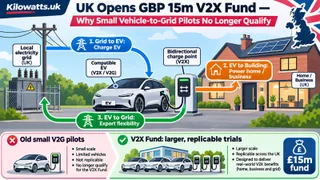
UKRI’s £15m V2X fund excludes small-scale vehicle-to-grid pilots
Small-scale vehicle-to-grid (V2G) pilots are ineligible for Innovate UK’s Scaling Interoperable V2X competition. The round opened on 10 November 2026 and offers up to £15 million for collaborative projects that demonstrate bidirectional EV charging at scale. Applicants must show that equipment and services from different organisations can work together and deliver measurable energy flexibility under real operating conditions across more than one season. Applications close at 11 am UK time on 27 January 2027. UKRI funding opportunity
The £15 million is the ceiling for the whole competition and depends on Innovate UK receiving enough high-quality applications. Households and fleets can take part in demonstrations. Projects that use EV batteries to supply a building behind the meter can also qualify if they meet the same requirements for scale, interoperability and evidence. Innovate UK competition scope
Who can apply for the £15 million competition?
A UK-registered business or research and technology organisation can lead a consortium with at least two other organisations. The project must involve partners and stakeholders from across the V2X supply chain. The consortium must include people with suitable energy system expertise or show how it will access that expertise. At least one technical partner must be or become an active participant in the International Energy Agency’s Task 53 on bidirectional charging interoperability. In the application, name who will design the flexibility service, agree how to meter it and verify delivery. Innovate UK eligibility criteria
The standard grant request is £2 million to £7.5 million per project, with a £3 million cap for any one enterprise across the competition. Funding rates for commercial work depend on the organisation’s size and the research category. EV purchase and lease costs are ineligible. Projects are normally expected to last 18 to 31 months, start by 1 June 2027 and finish by 31 December 2029. Innovate UK funding and project requirements
If your grant request or project duration falls outside the standard range, email a written justification to support@iuk.ukri.org at least 10 working days before the competition closes. Innovate UK decides whether to approve the exception. Build that earlier deadline into your application timetable if you need one. Innovate UK exception process
What must a demonstration prove at scale?
The demonstration must show that equipment and services from different organisations can work together and deliver dependable energy flexibility at scale. Installing more identical chargers can increase capacity. To demonstrate interoperability, specify which combinations of vehicles, chargers and control services you will test and what results would show they work together. Feasibility studies, lab-only projects and one-way charging projects are outside scope. The brief calls for measured flexibility data, evidence on user experience, modelling of how the system would scale up and battery health monitoring. Projects should align with relevant standards, including ISO 15118-20. Innovate UK demonstration requirements
At a depot, use actual van arrival and departure records to identify when vehicles can provide flexibility. Compare the service’s dispatch requests with metered delivery, then check that each van still has enough charge for its next route. Log the cause of any shortfall, such as a late return, early departure, driver override or site export limit. For a household demonstration, track across seasons how often cars are plugged in during the evening service window and how much energy is available after allowing for the next trip. When planning both types of demonstration, consider how workplace and home charging differ.
What can bidirectional EV charging do?
Vehicle-to-everything (V2X) covers ways a compatible electric vehicle can use its battery to supply electricity beyond the vehicle. Vehicle-to-grid exports to the electricity network. Vehicle-to-home or vehicle-to-building meets some demand on the premises, while vehicle-to-load powers individual equipment. If your main aim is to charge off-peak, one-way smart charging may be enough. UK government smart charging action plan
Overview
If you want power during an outage, ask the installer which circuits the system can supply and how it isolates them from the grid. Use a vehicle-to-load outlet only as directed by the manufacturer. Never use it to feed electricity into a wall socket. If you are also considering home battery backup, check which circuits that system could supply.
How much power can an EV deliver and what affects cost?
Power, measured in kilowatts (kW), tells you how quickly the system can discharge. Energy, measured in kilowatt hours (kWh), tells you how much it delivers over a period. Ask for the continuous discharge rating of your exact vehicle and charger combination, along with the site’s permitted export limit. Estimate how much energy is available while the car is plugged in. Keep enough charge for the next trip and deduct any electricity the building uses before the rest is exported.
OVO reported that vehicles in its UK domestic V2G trial exported an average of 6.7 kWh per vehicle per day and imported an average of 11.3 kWh per day between July and September 2020. The trial used centrally scheduled charging and export. The imported electricity also supported driving, which makes the two figures unsuitable for calculating conversion efficiency. For your own site, estimate delivery using actual plug-in times, trip requirements and the hours when the service needs power. OVO’s measured V2G trial results
Compare itemised quotes for bidirectional and one-way smart charging. Check whether each includes the cable run, consumer unit work, metering, export controls and recurring fees. Use the guide to EV charger installation costs to identify the standard installation items in each quote. Value electricity used on site at the import cost it avoids and exported electricity at the rate the provider pays. Allow for recharge costs and conversion losses. Check whether you can receive flexibility and export payments for the same delivery, and review the vehicle’s battery warranty terms for the proposed use.
Where V2X could work for UK homes and businesses
A home with off-street parking and a car plugged in most evenings is a practical candidate. If you live in a flat, check who controls the parking bay’s electricity supply. Ask the building manager or charge point operator who can authorise cabling or changes to shared chargers. Find out which meter records the electricity flows and who would receive any export payments. A car still needs a charging connection if you have balcony solar. Check what permissions a charge point needs before arranging installation.
Fleet depots can offer dependable charging windows when vans return on predictable schedules. Fast turnarounds and routes that require a near-full battery leave less energy available for discharge. Farms and construction businesses could contribute road-going electric vehicles if their schedules support measurable flexibility at scale. The competition excludes non-road-going vehicles. Innovate UK scope and vehicle eligibility
If the site already has solar or a stationary battery, ask how the equipment will share the site’s export capacity and which source will discharge first. If you are still planning the system, check how smart energy management can coordinate charging, generation and storage. In Great Britain, ask the installer to confirm the applicable G98 or G99 process with the local distribution network operator. GOV.UK guidance on registering V2G charge points In Northern Ireland, ask the installer to confirm the applicable connection route with NIE Networks. The installer will need the proposed charger model, its export rating and details of any existing generation or storage. NIE Networks publishes separate G98/NI forms for Stage 1 commissioning and Stage 2 applications. NIE Networks G98/NI Stage 1 commissioning form and Stage 2 application and commissioning forms.
What to check before buying or joining a trial
Get written confirmation that the function you want works with your exact UK vehicle variant, charger model, firmware and tariff or flexibility service. Ask who can schedule discharge, how you set a minimum charge and departure time, and whether a driver can override the schedule. Check what happens to charging and discharge if the internet connection drops. If you run a fleet, test those settings against actual vehicle movements before allocating bays to bidirectional charging.
Give each installer the same parking layout, plug-in hours and details of any existing solar or battery. If you are planning charging alongside solar or storage at home, you can arrange a home energy survey to discuss the setup. If your main objective is cheaper overnight charging, a one-way system may meet it. Bidirectional charging is worth assessing when the vehicle is regularly plugged in during the hours you need power and you have a specific use for the electricity it delivers.
Solar comparison
Compare solar for your property
Enter your postcode to assess your roof, compare solar options and get quotes from UK installers.
- Free postcode start
- Home, business and industrial
- RoboMo™ maps your roof
See which panels fit your roof
Choose home, business or industrial, then enter your postcode. RoboMo maps the roof and ranks panel brands by fit.
1. Postcode Start the assessment for your property.
2. Pin the roof Mark the array on the map.
3. Compare RoboMo™ builds your options.

Battery ROI tool
See what a battery saves on your bill
Enter the day rate, off-peak rate and export rate. The calculator ranks batteries in the Kilowatts shop over 10 years. Home batteries also suit offices and small commercial sites.
Reading
Sources and further reading
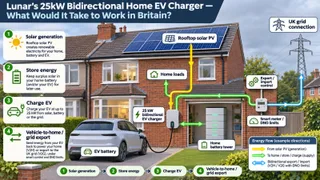
Could Lunar's 25 kW bidirectional EV charger work at your UK home? See how your car, electricity supply and export limits could affect what it can do.
Read article

A typical EV battery stores several times more than a home battery - but only bidirectional cars and chargers can send that energy back into the house.
Read article
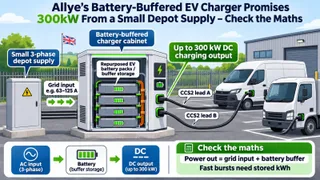
See whether Allye’s MEV300 EV charger can meet your UK fleet’s charging needs on a 63 A depot supply, and how battery recharge limits shape each shift.
Read article

Discover what Flower Turbines' UK Power Networks approval means for small wind buyers in the UK, and how it affects their projects.
Read article



Mo's Solar Mission
Mo's Mission Nominations
Garlinge Primary School and Nursery
Garlinge Primary School and Nursery is a foundation primary school on Westfield Road in Margate, Kent, for children aged 3 to 11. It is m...
St Luke's Church of England Primary SchoolSt Luke's Church of England Primary School is a voluntary controlled Church of England primary school on Jubilee Road in Formby, Merseysi...
Comberbach Nursery and Primary SchoolComberbach Nursery and Primary School is a primary academy on Mather Drive in the village of Comberbach, near Northwich in Cheshire, for...
Locations
Solar installation near you
Write for Kilowatts.uk
Got a trade and something worth saying?
Write it here under your own name. Sign in, put a profile up, and start a guide. Pay only if you want more links from your articles out to your own site.
Register
Create a Kilowatts.uk account, or sign in if you already have one.
Author profile
Put your name, photo and experience on a public author page.
Start creating
Write a guide or a blog. Free authors can put one followed link to their own site in articles each month.
FAQ
Need Help? RoboMo's Got Answers
Why are small vehicle-to-grid pilots excluded from the £15 million fund?
Innovate UK is funding demonstrations that show bidirectional charging can deliver measurable energy flexibility at scale across more than one season. Projects must also show that vehicles, chargers and control services from different organisations can work together under real operating conditions. A small pilot on its own falls outside the competition’s scope.
Can I get a grant from the fund for a home vehicle-to-grid charger?
The £15 million is the maximum available across the competition for collaborative projects led by eligible UK organisations. Households can take part in a qualifying demonstration if a project recruits them. Ask the project team what equipment, installation and ongoing costs it covers before signing up.
What is the difference between vehicle-to-grid and vehicle-to-home charging?
Vehicle-to-grid exports electricity from a compatible EV battery to the electricity network. Vehicle-to-home uses the battery to meet some of your household’s electricity demand. If your main aim is to charge the car when electricity is cheaper, one-way smart charging may be enough.
How do I check whether my EV and charger support bidirectional charging?
Get written confirmation that your exact UK vehicle variant, charger model and firmware support the function you want. Check that the combination works with your chosen tariff or flexibility service and ask the vehicle manufacturer how the proposed use affects the battery warranty. Ask how to set a minimum charge for your next trip and whether you can override the discharge schedule.
Can my EV power my home during a power cut?
If you want backup power, ask the installer whether your proposed vehicle-to-home system can operate during an outage. Confirm which circuits it can supply, how much power it can deliver and how it isolates those circuits from the grid. Never connect a vehicle-to-load outlet to a household wall socket to feed power into the home.
How can I work out whether bidirectional charging will save me money?
Estimate how much energy your car can supply during the hours you need it, allowing for plug-in times and the charge you need for your next trip. Value electricity used at home at the import rate it avoids and exported electricity at the rate your provider pays. Ask whether export and flexibility payments can both apply to the same electricity. Compare those benefits with installation costs, recurring fees and the cost of recharging, including conversion losses.
Can I install bidirectional charging if I already have solar panels or a home battery?
Ask your installer whether the proposed charger can work with your existing solar or battery controls. Check how the equipment will share any site export limit and which battery will discharge first. If the system will export to the grid, ask your installer to confirm the applicable connection process with your local distribution network operator in Great Britain or with NIE Networks in Northern Ireland.
Can I use bidirectional charging if I live in a flat?
Check who controls the electricity supply to your parking bay and who can authorise cabling or changes to a shared charger. Ask the building manager or charge point operator which meter would record the electricity flows and who would receive any export payments. Confirm that your vehicle can stay connected during the hours when the system needs to supply power.
Live help
Need help right now?
Talk to RoboMo™ and get instant answers.