


Self-Healing Solar Panels Could Hot-Swap Failed Cells - But So Far It Is Only a Simulation
Published: 2026-11-23 17:59:01
Updated: 2026-11-23 09:59:59
See how self-healing solar panels restored output within 5 ms of switching to a spare cell in simulation, and what UK rooftop trials still need to test.
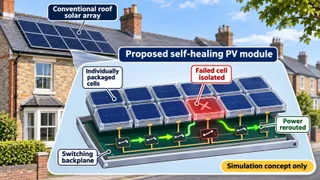
Self-healing solar panels can route around a failed cell in simulation
Self-healing solar panels could keep generating by isolating a failed photovoltaic (PV) cell and connecting a spare. In Liu and colleagues’ simulation, an open-circuit fault in one cell briefly cut output power by 1.8%. Output returned to its pre-fault level within 5 milliseconds of switching starting. The model included a separate 200-millisecond delay for fault detection. Physically replacing the failed cell would still require a service visit. The design has yet to be demonstrated on hardware or outdoors. *Scientific Reports*, section 4.1 and Figure 3
How the panel switches to a spare solar cell
The proposed design houses each solar cell in a replaceable package. When the controller detects a fault, a switching backplate disconnects the affected cell and connects a spare. The design also relies on cell-level power electronics, a communications network and active liquid cooling. The reliability of each would matter in service. *Scientific Reports*, proposed system architecture
The hot-swap would happen later, when a technician physically replaces the failed cell while the rest of the system keeps running. On a roof, the technician would need room to reach the cell, a way to confirm that the service connection is safely isolated, and a connector that can be resealed after replacement. Those steps still need to be demonstrated on hardware.
How hot-swappable cells compare with conventional panels
Conventional crystalline silicon modules typically seal their cells inside a laminate. Under partial shading, a bypass diode can carry current around a group of series-connected cells. That limits reverse voltage across the affected cells, while the bypassed group contributes less power to the module. The US National Renewable Energy Laboratory documents this behaviour in *Characterizing Shading Losses on Partially Shaded PV Systems*. In the proposed design, the controller switches out a single failed cell and connects a spare, restoring output in the simulation.
What the simulation tells us about output and cost
The study also modelled rated-output availability over 25 years. Equation 16 defines availability as the share of trials in which the array delivers at least 95% of the power expected from healthy cells under the same sunlight. Availability stayed high under the model’s assumptions about when cells failed and how the supply of spares was replenished each quarter. Annual generation in kWh, measured service life and bill savings would each need separate evidence. *Scientific Reports*, Equation 16 and 25-year availability analysis
Spare cells need sunlight to generate. If you want power during a grid outage, ask the installer which loads the system could supply and how it would operate safely while disconnected from the grid.
UK installation and servicing costs for the proposed design remain unknown. Energy Saving Trust gives a guide price of around £7,600 for a conventional 4.5 kWp domestic system. Kilowatt-peak (kWp) measures the array’s rated power under standard test conditions. Annual generation, measured in kilowatt-hours (kWh), depends on location, panel orientation, pitch and shading. Roof condition and access can also affect the installed price. Energy Saving Trust guide to solar panels
Where the design might earn its keep in the UK
A factory, farm or remote site could be a good place to test the design if lost generation is costly and a repair crew takes time to reach the site. Automatic switching could keep more of the array generating until a technician arrives. The business case for solar would depend on the value of the recovered electricity, the cost of stocking spares and the labour needed to reach the equipment. A roof that is hard to reach can make automatic recovery more valuable and cell replacement more expensive.
For a UK field trial, Kilowatts would compare the proposed system’s net annual AC generation with that of a conventional array on the same site under comparable conditions. The comparison would account for the electricity used by pumps and controls. The trial would measure how much power is lost when a pump or controller fails, check whether connectors stay weatherproof after repeated servicing and time how long it takes to isolate and replace a cell safely. Generation, downtime and maintenance labour would together show whether the extra equipment pays its way.
What to check if you are buying solar now
Start with a survey of shading, roof condition, cable routes and access for repairs. Ask each installer for a site-specific annual generation estimate and the assumptions behind it. Compare monitoring and warranty cover, and check who pays for access if a module needs replacing. If your business has half-hourly consumption data, compare it with the expected generation profile to estimate how much solar electricity the site could use directly. Energy Saving Trust guide to solar panels
For a balcony installation, check the usable area, shade from the building or balustrade, wind exposure and whether the mounting and cable route suit the property. Confirm permissions and connection requirements before ordering. For a grid-connected installation in Great Britain, ask the installer which G98 or G99 process applies and whether an export limit affects the design. In Northern Ireland, check the connection process with NIE Networks. Energy Networks Association distributed generation connection guide
Use the Kilowatts solar tools to explore what suits your property and the installer directory to find firms that can survey it. Give each firm the same consumption data and ask for a written generation estimate so you can compare quotes on the same basis.
Solar comparison
Compare solar for your property
Enter your postcode to assess your roof, compare solar options and get quotes from UK installers.
- Free postcode start
- Home, business and industrial
- RoboMo™ maps your roof
See which panels fit your roof
Choose home, business or industrial, then enter your postcode. RoboMo maps the roof and ranks panel brands by fit.
1. Postcode Start the assessment for your property.
2. Pin the roof Mark the array on the map.
3. Compare RoboMo™ builds your options.

Battery ROI tool
See what a battery saves on your bill
Enter the day rate, off-peak rate and export rate. The calculator ranks batteries in the Kilowatts shop over 10 years. Home batteries also suit offices and small commercial sites.
Reading
Sources and further reading
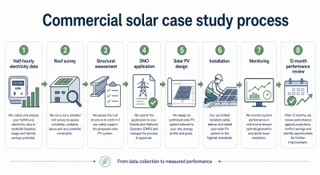
Case studies show how roof, load and DNO limits changed real UK commercial arrays. Read the site constraints, not just the kWp.
Read article
Solar panels want light, not heat. Here's why rising cell temperature cuts voltage and output, and why a cold bright British morning can beat a hot afternoon.
Read article
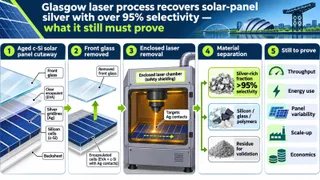
See what over 95% silver extraction selectivity means for Glasgow’s laser recycling trial and how to recycle your old solar panels in the UK.
Read article
Read article


Mo's Solar Mission
Mo's Mission Nominations
Garlinge Primary School and Nursery
Garlinge Primary School and Nursery is a foundation primary school on Westfield Road in Margate, Kent, for children aged 3 to 11. It is m...
St Luke's Church of England Primary SchoolSt Luke's Church of England Primary School is a voluntary controlled Church of England primary school on Jubilee Road in Formby, Merseysi...
Comberbach Nursery and Primary SchoolComberbach Nursery and Primary School is a primary academy on Mather Drive in the village of Comberbach, near Northwich in Cheshire, for...
Locations
Solar installation near you
Write for Kilowatts.uk
Got a trade and something worth saying?
Write it here under your own name. Sign in, put a profile up, and start a guide. Pay only if you want more links from your articles out to your own site.
Register
Create a Kilowatts.uk account, or sign in if you already have one.
Author profile
Put your name, photo and experience on a public author page.
Start creating
Write a guide or a blog. Free authors can put one followed link to their own site in articles each month.
FAQ
Need Help? RoboMo's Got Answers
What does ‘self-healing’ mean for a solar panel?
The proposed panel detects a failed solar cell, disconnects it and switches in a spare. A technician would still need to visit to replace the failed cell. The idea is that the rest of the system could keep generating during that replacement, once a safe servicing procedure has been demonstrated.
How quickly did the simulated panel recover after a cell failed?
In the simulation, one open-circuit cell fault briefly reduced output power by 1.8%. Output returned to its pre-fault level within 5 milliseconds of switching starting. The model included a separate 200-millisecond delay for detecting the fault.
How is this different from the bypass diodes in conventional solar panels?
A bypass diode can route current around a group of cells under conditions such as partial shading. The bypassed group contributes less power while current takes that route. The proposed design disconnects an individual failed cell and connects a spare to restore output, as shown in the simulation.
Can I buy these hot-swappable solar panels for my home in the UK?
The design described in the study is a research proposal that has only been tested in simulation. Its performance on physical hardware and outdoors remains unverified. UK installation and servicing costs for the design are also unknown.
Does the 25-year simulation mean the panels will last longer or cut my bills?
The simulation estimated how often the array would deliver at least 95% of the power expected from healthy cells under the same sunlight. That result depended on assumptions about cell failures and how often spares were replenished. Assessing service life and bill savings would require field evidence, including annual electricity generation and the energy used by pumps and controls.
Would spare solar cells keep my home powered during a power cut?
Spare cells are intended to restore output after a cell fault. Supplying your home during a power cut requires a system designed to operate safely while disconnected from the grid. If backup matters to you, ask the installer which appliances or circuits the system could support.
What should I ask installers if I’m buying solar panels now?
Ask each installer for a written annual generation estimate in kWh and check how they accounted for roof orientation, pitch and shading. Compare monitoring and warranty cover, including who pays for roof access if a panel needs replacing. If you want backup power, ask for that capability to be included in the quote.
Live help
Need help right now?
Talk to RoboMo™ and get instant answers.