


ACT-ion Opens a Continuous Cathode Pilot Plant - Can It Cut Battery Material Cost and Waste?
Published: 2026-11-24 09:17:37
Updated: 2026-11-24 01:18:24
See how ACT-ion’s continuous cathode pilot plant could cut cost and waste, and what evidence UK battery makers would need before buying its powder.
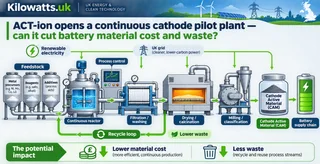
ACT-ion cathode pilot plant opens in Texas
ACT-ion’s continuous cathode pilot plant could cut battery material costs and waste if it makes more usable powder from the same inputs or uses less energy, water and feedstock per kilogram. The company opened the plant in Carrollton, Texas, on 3 November 2026. BASF Venture Capital, an ACT-ion investor, reports that the facility is producing cathode active material. The opening announcements give a capacity figure but disclose no measured savings that would support expectations of lower UK battery prices. ACT-ion plant opening release · BASF Venture Capital announcement
What does the pilot plant make?
Cathode active material, or CAM, is the powder that stores and releases lithium ions in the positive electrode of a lithium-ion cell. A cell manufacturer mixes the powder with other ingredients, coats the mixture onto metal foil and dries it to form an electrode. The Texas pilot makes the powder that goes into this process.
On a continuous line, feedstock enters and material moves through the equipment in an ongoing flow. Engineers can use the pilot to check whether the powder meets specification during long runs, after restarts and when the feedstock varies. ACT-ion says it has demonstrated the process with lithium iron phosphate (LFP) and nickel-cobalt-manganese (NCM) materials. The opening announcements give no breakdown of planned output by chemistry. BASF Venture Capital announcement
How much cathode material can the plant produce?
ACT-ion puts the plant’s capacity at 20 “tons” per year, a tenfold increase in its production capacity. The company does not specify whether it means US short tons or metric tonnes. The amount of powder the plant can sell in a year depends on how long the line runs, how much time it loses to maintenance and changeovers, and how much powder meets specification. The opening release gives no figures for sustained output or saleable yield. ACT-ion plant opening release
To estimate how much battery capacity that annual powder output could support, a cell maker would need to know how much powder goes into each cell, the cell’s energy rating in kilowatt-hours (kWh), and the production yields from electrode coating through to finished cells.
Can continuous cathode production cut cost and waste?
A continuous line can spread labour and equipment costs across more saleable powder if it keeps output steady and rejects low. ACT-ion says its process is designed to accept industrial-grade chemicals and recycled black mass, a mixture recovered from processed batteries. Extra purification, residue treatment or a higher reject rate can offset savings on feedstock. ACT-ion plant opening release
A 2015 Argonne National Laboratory study gives an independent baseline for material and energy use in specific cathode production routes, including LFP. A fair comparison would use the same chemistry, equivalent powder specifications and the same set of production steps. It would measure cost, energy use, fresh water use and waste per kilogram of powder that meets specification, including losses during start-up and changeovers. The published pilot data are insufficient to calculate those differences. Argonne study on material and energy flows in battery material production · ACT-ion plant opening release
What would make the Texas pilot relevant to UK manufacturing?
The UK Battery Strategy identifies domestic cathode and anode material production as part of building a more secure supply chain for cell manufacturers. The Texas pilot shows how a production process can move beyond the laboratory. The opening announcements identify no UK customer, supply agreement or manufacturing plan. UK Battery Strategy · ACT-ion plant opening release
A UK cell maker would use samples from several runs to qualify the powder. It would check that particle size, moisture and impurities stay within agreed limits, then test how the material performs on its electrode coating line and in its cells. The buying decision would also depend on whether ACT-ion could supply consistent volumes at the required lead time and delivered cost. UK manufacturers reviewing site electricity costs can also compare solar for industrial sites against their daytime demand.
What should UK battery buyers compare today?
Share your electricity usage profile with installers and ask each to quote usable storage in kWh and continuous discharge power in kW. If you already have solar panels, give the installer your inverter model and ask how the battery would connect. If you want the battery to charge at cheaper times, check whether its scheduling works with your tariff and what happens if the internet connection drops.
If you need backup during a power cut, ask which circuits the system can supply, how much power it can deliver and how much charge it can hold in reserve.
Solar comparison
Compare solar for your property
Enter your postcode to assess your roof, compare solar options and get quotes from UK installers.
- Free postcode start
- Home, business and industrial
- RoboMo™ maps your roof
See which panels fit your roof
Choose home, business or industrial, then enter your postcode. RoboMo maps the roof and ranks panel brands by fit.
1. Postcode Start the assessment for your property.
2. Pin the roof Mark the array on the map.
3. Compare RoboMo™ builds your options.

Battery ROI tool
See what a battery saves on your bill
Enter the day rate, off-peak rate and export rate. The calculator ranks batteries in the Kilowatts shop over 10 years. Home batteries also suit offices and small commercial sites.
Reading
Sources and further reading
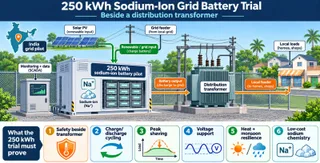
Jaipur's 250 kWh sodium-ion battery trial will test whether storage can ease peak transformer loads. See what UK battery buyers can learn about sizing.
Read article
Practical UK guide on how much does one battery cost. Clear answers for homeowners comparing options and next steps.
Read article
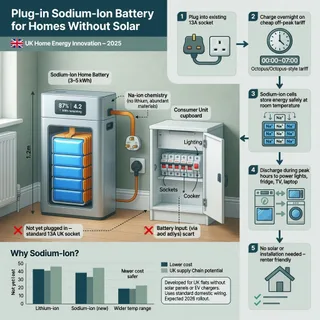
A plug-in sodium-ion battery for homes without solar is in development, not on sale. UK grid rules may still block a simple wall-socket connection.
Read article

In the UK, a typical installed house battery is commonly budgeted from around £3,000 to £12,000+, depending on usable capacity, inverter choice.
Read article


Mo's Solar Mission
Mo's Mission Nominations
Garlinge Primary School and Nursery
Garlinge Primary School and Nursery is a foundation primary school on Westfield Road in Margate, Kent, for children aged 3 to 11. It is m...
St Luke's Church of England Primary SchoolSt Luke's Church of England Primary School is a voluntary controlled Church of England primary school on Jubilee Road in Formby, Merseysi...
Comberbach Nursery and Primary SchoolComberbach Nursery and Primary School is a primary academy on Mather Drive in the village of Comberbach, near Northwich in Cheshire, for...
Locations
Solar installation near you
Write for Kilowatts.uk
Got a trade and something worth saying?
Write it here under your own name. Sign in, put a profile up, and start a guide. Pay only if you want more links from your articles out to your own site.
Register
Create a Kilowatts.uk account, or sign in if you already have one.
Author profile
Put your name, photo and experience on a public author page.
Start creating
Write a guide or a blog. Free authors can put one followed link to their own site in articles each month.
FAQ
Need Help? RoboMo's Got Answers
What does ACT-ion’s Texas pilot plant make?
The plant makes cathode active material, a powder used in the positive electrode of lithium-ion cells. ACT-ion says it has demonstrated its process with lithium iron phosphate (LFP) and nickel-cobalt-manganese (NCM) materials. The company has yet to say how much of each chemistry the pilot will produce.
How much cathode material can the pilot plant produce?
ACT-ion reports a capacity of 20 ‘tons’ a year, with the unit unspecified. The amount of usable powder depends on how long the line runs and how much of its output meets specification. The opening announcement gives no figures for sustained output or saleable yield.
Can continuous cathode production cut waste?
It could if the line produces more usable powder from the same inputs or generates fewer rejects. ACT-ion says the process is designed to accept black mass recovered from used batteries, though extra purification or residue treatment could offset some savings. The opening announcements give no measured figures for waste, energy or water use per kilogram of usable powder.
Could the Texas pilot make home batteries cheaper in the UK?
The pilot gives UK buyers little basis to expect lower prices. ACT-ion has yet to publish measured production savings, and cathode powder is only one part of the cost of a fitted home battery. Cell manufacturing, the inverter and installation also affect the price you pay.
Will ACT-ion’s cathode material be used in batteries sold in the UK?
The opening announcements name no UK customer, supply agreement or manufacturing plan. A cell maker would first need to check the powder’s consistency across production runs and test how it performs in finished cells. It would also need confidence in delivered cost and supply volumes.
What should I compare when getting quotes for a home battery?
Ask each installer for usable storage capacity in kWh and continuous discharge power in kW. Usable capacity tells you how much energy you can draw from a charge, while discharge power tells you how much the battery can supply at once. If you already have solar panels, share your inverter model and ask how the battery would connect. If you plan to charge at cheaper times, check that the battery’s scheduling works with your tariff.
Will a home battery keep my lights on during a power cut?
That depends on whether the system is configured to provide backup power. Ask the installer which circuits it can supply, how much power it can deliver and how much charge you can set aside for an outage.
Live help
Need help right now?
Talk to RoboMo™ and get instant answers.