


How much to have a car charger installed?
Published: 2026-11-26 01:05:33
Updated: 2026-11-25 17:06:13
Practical UK guide on How much to have a car charger installed. Clear answers for homeowners comparing options and next steps.
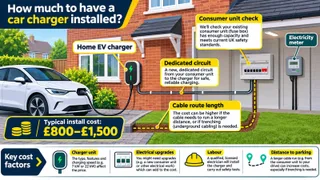
How much does it cost to install a home EV charger in the UK?
Budget around £800–£1,300 to buy and fit a typical 7 kW home EV charger, before any grant. That’s the range in Octopus EV’s guide, checked in November 2026. It’s a starting point if you have private parking, an accessible cable route and a suitable electricity supply. A longer cable run, trenching, a freestanding post or extra electrical work can raise the price. Ask for a written quote that sets out what the fitting covers and gives the total including VAT. Octopus EV installation cost guide
In the same November 2026 check, Ohme listed standard installation prices starting at £949 for its ePod and £999 for its Home Pro. The final quote depends on the installer and the property. You’ll also pay for the electricity you use to charge the car. Ohme installation guidance
What should a standard EV charger installation include?
Ask whether the fitted price covers the chargepoint, mounting, a dedicated circuit, electrical protection, testing and commissioning. Check how much cable is included, what drilling the price covers and whether the installer will help you set up the app. Ask which electrical installation certificate you’ll receive. Each supplier defines its own standard installation, so two quotes for the same charger can cover different work. Ohme standard installation specification
A tethered charger has a permanently attached lead. An untethered charger has a socket and needs a separate compatible lead. Before agreeing where to mount the charger, park as you normally would and check where the charging port sits. If you sometimes reverse in, make sure the lead reaches in both positions without crossing a walkway. Ohme home charger comparison
What can push the installation price above £1,300?
A charger beside the driveway can still need a long cable run if the consumer unit is at the back of the house. The installer measures the route the cable will follow around corners and through walls. Ask how many metres the standard price covers, what each extra metre costs and whether drilling, ducting or groundwork is priced separately. Ohme standard installation specification
Overview
The installer should check the incoming supply and what else might draw power while the car charges. If you have an electric shower or heat pump, ask whether the quote includes dynamic load management. This reduces charger output when the house is using a lot of electricity. Depending on the supply and proposed work, the installer may need to notify the distribution network operator after fitting or get approval beforehand. Ask who handles this and whether it affects the fitting date. Energy Networks Association connection process
What did an installation with a separate consumer unit cost?
In November 2026, Power EV’s Gavin Rogers published a £1,031.30 quote he accepted for his home in North Wales. It covered a 7.4 kW tethered charger mounted on a garage pillar and a separate small consumer unit in the garage. The charger cost £479.99, labour cost £325 and connection materials came to £226.31. The materials included £104.68 for the separate consumer unit and £59.99 for cable, plus meter tails, connector blocks and clips. Power EV’s published installation quote
The quote showed no separate VAT line, so it’s unclear whether the total included VAT. It gave no cable length or per-metre rate and listed no trenching, paving reinstatement or freestanding post. The £104.68 covered the consumer unit itself, with labour priced separately for the whole job. To compare it with your quote, ask for the fitted price of any separate enclosure and have the installer price any extra cable along the measured route. Power EV’s published installation quote
Is a 7 kW charger enough for your car?
A 7 kW chargepoint suits many homes with a single-phase supply where the car can charge overnight. At a steady 7 kW, it draws 30 kWh of electricity in about four hours and 20 minutes. Adding 30 kWh to the battery takes longer because some energy is lost during charging. The car’s onboard AC charger and any limit set by the installation can also reduce the charging rate. Octopus EV home charging guide
Work out how much energy you usually need to replace after a day’s driving and how long the car is parked. If your tariff has a short cheap-rate window, check how much energy the car can take in that time at the charging rate your installation can sustain. Smart scheduling can shift charging into those hours.
Can a grant reduce the installation cost?
The two home chargepoint grants from the Office for Zero Emission Vehicles (OZEV) each cover up to 75% of eligible chargepoint and installation costs, capped at £500. Both have a published closing date of 31 March 2027. Use an OZEV-authorised installer and an eligible charger. Check the installer’s authorisation and application timing before booking, and wait for OZEV to confirm your eligibility before fitting. Ask the installer to show the grant deduction separately on the quote. GOV.UK chargepoint grant guidance
If you rent your home or own and live in a flat, you may qualify if you have private off-street parking. Get any required permission from the landlord, freeholder or managing agent before applying. In a block of flats, agree the cable route through any shared areas before the installer prices the work. Apply for the renters and flat owners grant
If you only have on-street parking, a separate scheme can help pay for the chargepoint if you’re also installing an approved cross-pavement solution, such as a recessed cable channel. Get consent from your local highway authority before applying, check whether you need planning permission and have the pavement work priced separately. You’ll still need to find a space within reach of the charger, so check how often one is available. Apply for the on-street parking grant
How to get an EV charger quote you can compare
Send each installer the same photos of the meter area, closed consumer unit, likely cable route and parking space. Give them the car model and show where its charging port sits when you park. Mention paving, shared areas and detached garages in your first enquiry so the installer can decide whether to visit before confirming the price. Ohme installation guidance
Use the Kilowatts UK installer directory to find EV chargepoint installers and request itemised quotes. Compare the total including VAT and before any grant. Check what each quote covers for the agreed cable route, cable allowance, electrical work, groundwork, testing and commissioning. If the price is provisional, ask which items could change after the survey. Confirm who will approve and pay for any extra work before it starts. If you’re planning other energy upgrades alongside the charger, you can arrange a free survey with Kilowatts UK.
Solar comparison
Compare solar for your property
Enter your postcode to assess your roof, compare solar options and get quotes from UK installers.
- Free postcode start
- Home, business and industrial
- RoboMo™ maps your roof
See which panels fit your roof
Choose home, business or industrial, then enter your postcode. RoboMo maps the roof and ranks panel brands by fit.
1. Postcode Start the assessment for your property.
2. Pin the roof Mark the array on the map.
3. Compare RoboMo™ builds your options.

Battery ROI tool
See what a battery saves on your bill
Enter the day rate, off-peak rate and export rate. The calculator ranks batteries in the Kilowatts shop over 10 years. Home batteries also suit offices and small commercial sites.
Reading
Sources and further reading
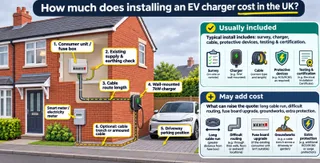
Budget £800–£1,200 for a typical UK home EV charger installation. Compare VAT-inclusive quotes and see how cable routes and groundworks affect the price.
Read article
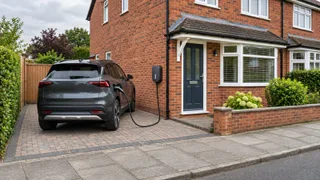
Practical UK guide on How much does installing ev charging station cost in the UK. Clear answers for homeowners comparing options and next steps.
Read article
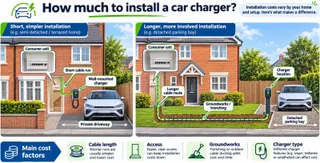
Ohme and Octopus Energy advertise home EV charger packages from around £950 to £1,130, including standard installation and before any grant.
Read article
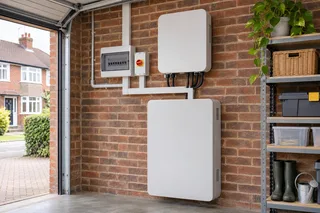
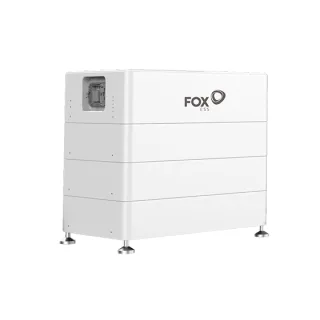
Compare UK home battery storage costs across three sizes and see how standalone, retrofit and new solar installations affect the fitted price.
Read article




Mo's Solar Mission
Mo's Mission Nominations
Garlinge Primary School and Nursery
Garlinge Primary School and Nursery is a foundation primary school on Westfield Road in Margate, Kent, for children aged 3 to 11. It is m...
St Luke's Church of England Primary SchoolSt Luke's Church of England Primary School is a voluntary controlled Church of England primary school on Jubilee Road in Formby, Merseysi...
Comberbach Nursery and Primary SchoolComberbach Nursery and Primary School is a primary academy on Mather Drive in the village of Comberbach, near Northwich in Cheshire, for...
Locations
Solar installation near you
Write for Kilowatts.uk
Got a trade and something worth saying?
Write it here under your own name. Sign in, put a profile up, and start a guide. Pay only if you want more links from your articles out to your own site.
Register
Create a Kilowatts.uk account, or sign in if you already have one.
Author profile
Put your name, photo and experience on a public author page.
Start creating
Write a guide or a blog. Free authors can put one followed link to their own site in articles each month.
FAQ
Need Help? RoboMo's Got Answers
How much does it cost to install a home EV charger in the UK?
Budget around £800 to £1,300 to buy and fit a typical 7 kW home charger before any grant. That’s a starting point for a property with private parking, an accessible cable route and a suitable electricity supply. Ask for a written quote showing the total including VAT.
What should a standard EV charger installation quote include?
Check that the quote covers the charger, mounting, a dedicated circuit, electrical protection, testing and commissioning. Ask how much cable and drilling are included and which electrical installation certificate you’ll receive. Installers set their own standard allowances, so compare what each quote covers for the agreed cable route.
What can make an EV charger installation cost more?
A long cable run, trenching, repairs to paving or a freestanding mounting post can all add to the bill. If there’s limited space in your consumer unit, the installer may need to fit a separate enclosure for the charger’s circuit protection. Ask for these extras to be priced separately before you book.
Can I get a grant towards a home EV charger?
You may be eligible if you rent your home or own and live in a flat and have private off-street parking. There’s a separate scheme for households with on-street parking that are installing an approved way to route the cable across the pavement. Check the current GOV.UK eligibility and application guidance before booking, and ask the installer to show any grant deduction separately.
Can I install a home EV charger if I only have on-street parking?
It may be possible if your local highway authority agrees to a solution such as a recessed pavement cable channel. Check what permissions you need and ask for a separate price for the pavement work. You’ll also need to be able to park within reach of the charger.
Is a 7 kW charger fast enough for overnight charging?
A 7 kW charger is fast enough for many drivers to replace a day’s driving overnight. At a steady 7 kW it draws 30 kWh in about four hours and 20 minutes, though adding that much to the battery takes longer because of charging losses. Check the car’s maximum AC charging rate and how much energy you can add during your tariff’s cheaper hours.
How much does it cost to charge an electric car at home once the charger is installed?
Multiply the electricity drawn by the charger in kWh by the unit rate you pay during charging. For example, if the charger draws 30 kWh and your tariff charges 10p per kWh at that time, the session costs £3 in electricity. Use the energy drawn from the supply for the calculation, as some energy is lost before it reaches the battery.
Live help
Need help right now?
Talk to RoboMo™ and get instant answers.