


This UK Battery Microscope Watches Individual Particles Charge - Why ZEISS Backed Illumion
Published: 2026-11-24 11:01:58
Updated: 2026-11-24 03:02:41
See how Cambridge spinout Illumion’s battery microscope tracks individual particles during charging and what its £1.7 million funding round will support.
Why ZEISS Ventures backed Illumion’s battery microscope
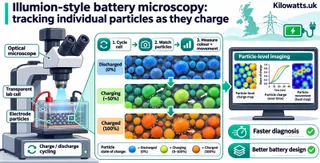
Illumion’s battery microscope uses charge photometry to track how individual electrode particles respond as a laboratory cell charges and discharges. ZEISS announced its participation in the Cambridge spinout’s £1.7 million funding round on 28 October 2026. Boris Hofmann, head of ZEISS Ventures, highlighted the ability to see changes in individual particles as they happen, helping researchers understand how battery materials behave during cycling. Cambridge Enterprise reported the following day that ZEISS Ventures and Foresight Group co-led the round. Cambridge Enterprise funding announcement
The funding supports commercialisation of illumionONE, a benchtop instrument for studying battery materials, and development of illumionX for selected industrial applications. Cambridge Enterprise identified quality control as a potential use for illumionX. To establish its value on a production line, manufacturers would need evidence that its measurements can reliably guide manufacturing decisions. Cambridge Enterprise funding announcement
How charge photometry tracks individual battery particles
Charge photometry is a form of optical microscopy that measures changes in the light scattered by electrode particles while a cell is working. When lithium enters or leaves certain electrode materials, it changes their electronic structure. This can affect how much light the microscope detects. Researchers compare changes in brightness with the cell’s electrical readings to infer when and where the material takes up or releases lithium. Imaging the cell during cycling makes this an *operando* measurement. Illumion’s technical explanation
In the peer-reviewed study *Optimal Coin Cell Design for Operando Optical Characterisation of Lithium-Ion Batteries*, researchers used illumionONE to image lithium cobalt oxide in a windowed half-cell. During charging, several darker regions appeared around the edge of one particle, grew and merged. During discharge, a brighter region spread from a single location in the image. The researchers attributed these patterns to the formation and growth of phases with different lithium contents. The images revealed where changes began within the particle, beyond the detail available from the cell’s voltage trace. University of Cambridge study on optical coin-cell design
The research team assembles a coin cell with an optical window and places it under the microscope. An integrated potentiostat controls the charge and discharge programme. The instrument synchronises each image with the cell’s current and voltage readings, so researchers can see whether neighbouring particles respond at different points in the same cycle. illumionONE measurement workflow
What illumionONE measures and how to check the results
Illumion specifies a lateral resolution of 350 nanometres and a field of view of 112 by 70 micrometres. Resolution describes the detail the optics can distinguish across the image. The field of view is the area captured in one frame. Each frame covers a small part of the electrode, so imaging several regions helps establish whether a pattern is widespread or confined to a few particles. Illumion’s instrument specifications
The windowed cell can influence the result. The way the electrode is mounted and the rate at which the cell is cycled can affect how closely the experiment represents a conventional cell. In the Cambridge study, some windowed designs performed comparably to standard coin cells under the lithium cobalt oxide half-cell conditions tested. To compare two formulations, a lab can prepare both in the same way, run the same cycling programme and benchmark the windowed setup against conventional coin cells at the intended test rates. University of Cambridge study on optical coin-cell design
Illumion’s public product information gives no UK purchase price for illumionONE. When requesting a quote, ask which installation, training and servicing costs it includes. Estimate the cost of windowed cell consumables using the number of repeat tests the lab expects to run. illumionONE product information, Illumion’s technical specifications and consumables
What the research means for UK battery storage buyers
The immediate use is in battery development. A materials team could use particle images to decide which electrode formulation to test further or to investigate why a formulation behaves differently at a faster charging rate. To show that a change extends the life of a home battery or a commercial battery, manufacturers would need durability data from representative production cells and finished packs tested under relevant operating conditions.
When sizing a home battery, start with what you want to power and for how long. Usable capacity in kWh tells you how much energy the battery can supply. Continuous output in kW tells you how much demand the system can meet at any one time.
If you’re adding storage to existing solar, ask the installer to confirm inverter compatibility. If you need backup during a power cut, ask which circuits the battery can supply during an outage and how much power it can deliver. Check that the warranty covers the way you intend to use the system. If you’re considering solar and storage for your home, you can book a free survey to discuss your electricity use and what you want the system to power.
Solar comparison
Compare solar for your property
Enter your postcode to assess your roof, compare solar options and get quotes from UK installers.
- Free postcode start
- Home, business and industrial
- RoboMo™ maps your roof
See which panels fit your roof
Choose home, business or industrial, then enter your postcode. RoboMo maps the roof and ranks panel brands by fit.
1. Postcode Start the assessment for your property.
2. Pin the roof Mark the array on the map.
3. Compare RoboMo™ builds your options.

Battery ROI tool
See what a battery saves on your bill
Enter the day rate, off-peak rate and export rate. The calculator ranks batteries in the Kilowatts shop over 10 years. Home batteries also suit offices and small commercial sites.
Reading
Sources and further reading

Yes - a home battery can fill from cheap off-peak grid electricity, then run your house through the expensive peak. Here's how it works in UK homes.
Read article
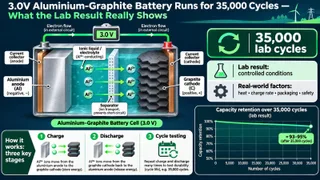
See why 3.0 V is the charge cut-off, how aluminium-graphite battery capacity fell over 35,000 lab cycles and what UK storage buyers still need to know.
Read article
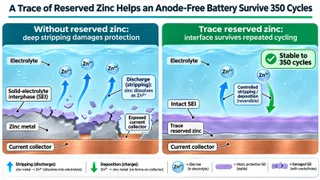
An anode-free zinc pouch cell retained 90.47% of its capacity after 350 lab cycles. See how the zinc reserve helps and what UK solar storage buyers need.
Read article

See if a domestic wind turbine and battery storage suit your UK home. Check your site’s wind yield, size a battery and weigh savings against export income.
Read article



Mo's Solar Mission
Mo's Mission Nominations
Garlinge Primary School and Nursery
Garlinge Primary School and Nursery is a foundation primary school on Westfield Road in Margate, Kent, for children aged 3 to 11. It is m...
St Luke's Church of England Primary SchoolSt Luke's Church of England Primary School is a voluntary controlled Church of England primary school on Jubilee Road in Formby, Merseysi...
Comberbach Nursery and Primary SchoolComberbach Nursery and Primary School is a primary academy on Mather Drive in the village of Comberbach, near Northwich in Cheshire, for...
Locations
Solar installation near you
Write for Kilowatts.uk
Got a trade and something worth saying?
Write it here under your own name. Sign in, put a profile up, and start a guide. Pay only if you want more links from your articles out to your own site.
Register
Create a Kilowatts.uk account, or sign in if you already have one.
Author profile
Put your name, photo and experience on a public author page.
Start creating
Write a guide or a blog. Free authors can put one followed link to their own site in articles each month.
FAQ
Need Help? RoboMo's Got Answers
What does Illumion’s battery microscope actually see?
It records changes in how individual electrode particles scatter light as a laboratory cell charges and discharges. By comparing those images with current and voltage readings, researchers can infer where lithium is entering or leaving certain electrode materials.
Why did ZEISS Ventures back Illumion?
ZEISS Ventures highlighted the microscope’s ability to show how individual particles change during battery cycling. The funding supports the commercial rollout of illumionONE for battery research and the development of illumionX for potential industrial uses such as quality control.
Could this research make home batteries last longer?
It could help researchers identify electrode materials worth testing for longer life. To show an improvement that matters to homeowners, manufacturers would still need durability data from representative production cells and finished battery packs tested under relevant conditions.
What should I check when comparing home battery warranties?
Check how long the warranty lasts and how much usable capacity it promises the battery will retain. Look for any limit on the number of cycles or the total energy the battery can deliver under warranty. Ask whether your planned use, such as daily charging from the grid, is covered.
How do I work out what size home battery I need?
Start with how much electricity you typically use during the hours you want the battery to cover. Compare usable capacity in kWh to see how much energy the battery can supply and continuous output in kW to see which appliances it can run at the same time.
Can I add a battery to my existing solar panels?
Many existing solar installations can be fitted with battery storage. Ask your installer whether your current inverter can work with the proposed battery and what additional equipment the installation would need.
Will a home battery keep my appliances running during a power cut?
That depends on whether the system is designed and installed to provide backup power. Ask which circuits it can supply during an outage, how much power it can deliver and how long it could run your essential appliances.
Live help
Need help right now?
Talk to RoboMo™ and get instant answers.